


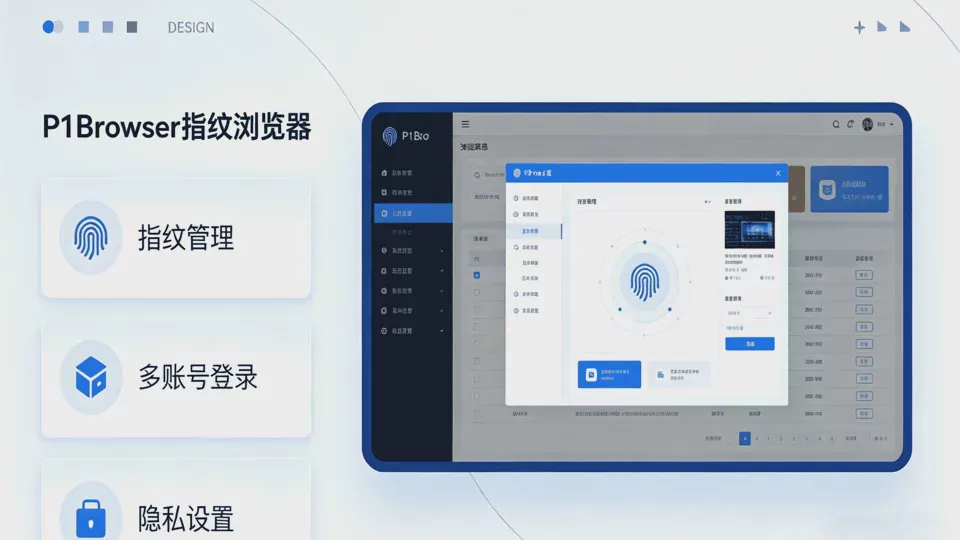
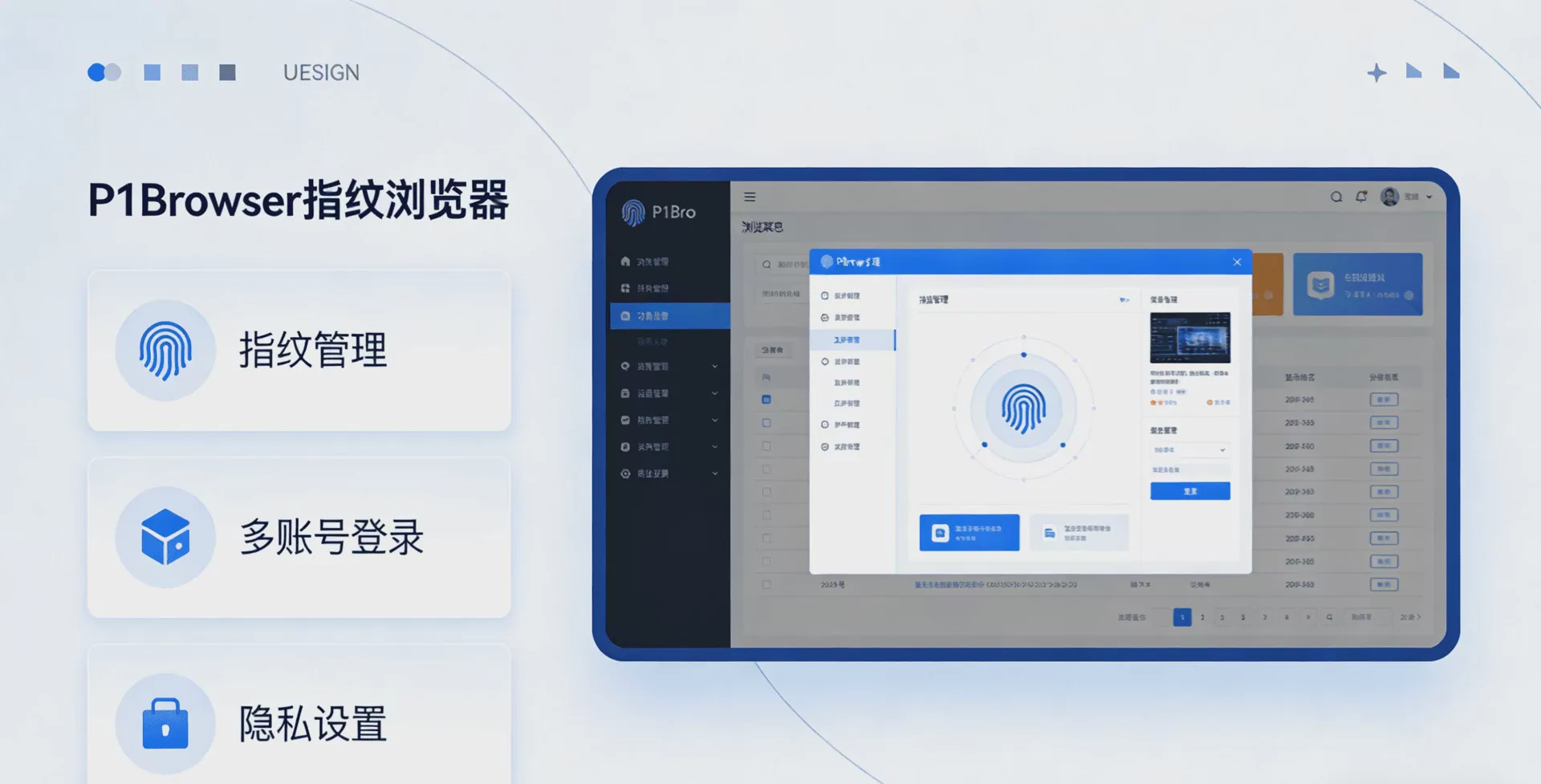
As cross-border e-commerce and overseas social media marketing enter an era of refined operations, the risk control systems of international platforms such as Amazon, Facebook, TikTok, Shopee, and Google Ads continue to evolve. The core challenge of multi-account operations has shifted from “whether operations are possible” to “how to operate at scale safely, efficiently, and compliantly.” The limitations of a single environment in traditional browsers and the superficial simulation shortcomings of ordinary fingerprint tools have left countless cross-border professionals facing the threefold dilemma of “account association bans,” “low operational efficiency,” and “delayed risk control adaptation.” P1Browser fingerprint browser breaks away from the industry’s homogeneous competition. Centered on “underlying technology reconstruction + in-depth scenario adaptation,” it breaks through the functional boundaries of traditional tools and provides cross-platform, multi-account operations with a full-link solution ranging from security protection to efficiency improvement, redefining the value dimensions of fingerprint browsers.
Unlike most products on the market that are secondary wrappers based on existing browser engines, P1Browser uses “native engine reconstruction + full-dimensional fingerprint simulation” as its technological foundation, thoroughly addressing the industry pain points of traditional fingerprint browsers: “low fingerprint simulation fidelity, incomplete environment isolation, and excessive resource consumption.” Its core innovation lies not in simply simulating surface-level browser parameters, but in building a four-dimensional coordinated simulation system covering “hardware-system-software-behavior,” giving every virtual environment unique and unreproducible “real device characteristics.” This perfectly adapts to the multidimensional risk control detection logic of platforms such as Amazon and Facebook, eliminating account association risks at the source.
Core Technological Innovation: More Than “Disguise”—“Native-Level Simulation”
P1Browser’s core competitiveness lies in overcoming the technical bottlenecks of traditional fingerprint browsers. Through three core innovative technologies, it establishes a security protection system far exceeding industry standards while taking operational efficiency and compliance into account, shifting multi-platform, multi-account operations from “passively avoiding bans” to “proactive compliance.”
1. Full-Dimensional Dynamic Fingerprint Engine: Solving the Industry Challenge of Static Fingerprints Being Easily Tracked
Traditional fingerprint browsers mostly use a “fixed-parameter simulation” model, covering only superficial browser parameters such as Canvas, WebGL, and UA. They are easily identified by the risk-control systems of platforms such as Amazon and Google Ads as “abnormal devices,” resulting in persistently high account suspension rates. P1Browser’s self-developed full-dimensional dynamic fingerprint engine collects 128 fingerprint parameters across four dimensions: the browser kernel layer, hardware information layer, operating system layer, and network behavior layer. Using machine learning algorithms, it builds a sample library of millions of real device fingerprints. Every generated fingerprint features three key characteristics: “uniqueness, randomness, and authenticity.”
More innovatively, this engine supports dynamic, adaptive adjustment of fingerprint parameters. Based on differences in the risk-control rules of platforms such as Amazon, Facebook, and TikTok, it automatically optimizes fingerprint parameter combinations. For Amazon, which focuses on detecting hardware fingerprints and network behavior, it enhances the simulation accuracy of hardware parameters such as the CPU and GPU. For TikTok and Facebook, which monitor user behavior, it dynamically simulates real users’ browsing and interaction patterns to prevent risk-control alerts triggered by mechanical actions. This “different profiles for different users” dynamic fingerprint strategy ensures that each account operates in an independent and authentic environment, reducing the risk of account association by more than 99% and completely solving the pain points faced by cross-border professionals: “difficult account nurturing and even more difficult account maintenance.”
2. Hardware-Level Sandbox Isolation Technology: Creating a Native Isolated Environment with “One Person, One Device”
The core risk of account association lies in different accounts sharing device resources and network environments, allowing platforms to identify account relationships by comparing underlying characteristics. P1Browser eliminates the shortcomings of traditional process-level sandbox isolation and uses customized lightweight KVM virtualization technology to build an independent hardware-level virtual operating environment for each account. It completely isolates cookies, cache, browsing history, hardware information, and network connections, truly providing “one independent virtual device for each account.”
Compared with traditional sandbox isolation, P1Browser’s hardware-level isolation technology offers three major advantages. First, isolation is more thorough: it prevents the flow of environmental information and resource contention at the underlying level. Even when dozens of Amazon and Shopee store accounts are running simultaneously, there will be no parameter leakage or environment association. Second, startup is faster: by removing redundant modules from the virtualization kernel, the startup time for a single virtual environment is reduced to within 3 seconds, meeting the need for efficient parallel operation of multiple accounts. Third, resource usage is lighter: using a “memory sharing + dynamic resource scheduling” algorithm, launching 20 virtual environments simultaneously consumes only 30% of the memory required by traditional virtualization technology, avoiding computer slowdowns and crashes caused by running multiple environments in parallel and meeting the practical needs of cross-border professionals operating at scale.
3. Intelligent Risk-Control Adaptation System: Tracking Platform Rules in Real Time and Moving from “Passive Defense” to “Proactive Adaptation”
The risk-control rules of overseas platforms such as Amazon, Facebook, and Google Ads are continuously updated in real time. Due to delayed adaptation, traditional fingerprint browsers often face the awkward situation of “working today but getting banned tomorrow.” P1Browser has built an intelligent risk-control adaptation system that uses crawler technology to capture risk-control rule updates from 20+ major overseas platforms in real time and completes iterative optimization of fingerprint-generation strategies and environment configurations within 30 minutes, ensuring that every virtual environment remains compatible with the latest platform risk-control requirements.
For example, when Facebook upgrades its account registration risk-control rules and strengthens its checks on IP purity and device fingerprint consistency, P1Browser can automatically adjust its IP-matching strategy, prioritize static residential IPs, and optimize device fingerprint parameters at the same time, ensuring that newly registered accounts pass risk-control reviews smoothly. When Amazon strengthens its monitoring of store operation behavior and prohibits bulk modification of product information within a short period, the system can automatically limit the operation frequency and simulate the pace of real sellers’ actions to avoid risk-control alerts. This “real-time adaptation and dynamic adjustment” capability enables P1Browser to respond calmly to various platform risk-control upgrades and provide round-the-clock protection for account security.
Core Features Explained: Precise Adaptation to Multiple Overseas Platforms While Balancing Security and Efficiency
All of P1Browser’s features are designed around operating scenarios on overseas platforms such as Amazon, Facebook, TikTok, Shopee, and Google Ads. Rejecting “feature accumulation,” it focuses on “practicality, efficiency, and compliance,” ensuring that every feature addresses real operational pain points and helps cross-border professionals achieve profitable operations at scale.
1. Dedicated Multi-Platform Adaptation: One-Stop Coverage of Core Cross-Border Scenarios
To meet the operational needs of different overseas platforms, P1Browser provides dedicated adaptation solutions. No additional configuration is required to quickly switch between scenarios and manage accounts across multiple platforms from a single interface:
On cross-border e-commerce platforms such as Amazon and Shopee, it supports the rapid creation, duplication, and switching of multiple stores, with built-in tools commonly used for store operations. It enables the synchronized management of product listings, order processing, review maintenance, and other tasks, while strengthening the consistency of IP addresses and hardware fingerprints to mitigate the risk of store association and bans, helping sellers build a secure store matrix. On social media platforms such as Facebook and TikTok, it supports the entire process, including account registration, content publishing, follower management, and ad placement. It simulates real user interactions to improve account standing and reduce the likelihood of ad delivery restrictions and account bans. On the Google Ads platform, it supports isolated operations for multiple advertising accounts, precisely matching the IP location requirements for ad placement, avoiding delivery restrictions caused by advertising account associations, and improving advertising ROI.
2. Efficient Batch Operations: Reducing Labor Requirements and Improving Scalable Operational Efficiency
One of the key challenges of cross-border multi-account operations is that manual processes are cumbersome and inefficient. This is especially true when the number of accounts reaches dozens or hundreds, as manually switching environments and configuring parameters requires a tremendous amount of work. P1Browser focuses on improving efficiency by providing full-process batch operation capabilities, freeing users from repetitive, mechanical tasks.
It supports the batch creation and duplication of virtual environments, allowing the parameters of a mature account environment to be copied to multiple environments with one click, eliminating the need for repeated configuration and saving 80% of the time required to set up environments. Built-in automated operation scripts can perform tasks such as batch product listing on Amazon, scheduled content publishing on TikTok, and batch adjustments to Google Ads campaigns. Custom script configurations are supported to meet the specific needs of different operational scenarios. It also supports centralized multi-account management, allowing users to view the operating status of all accounts in real time and quickly switch between account environments without repeatedly logging in and out, significantly improving operational efficiency. In addition, P1Browser supports team collaboration management, enabling administrators to set different operating permissions for members and record operation histories, making it easier for enterprises to manage processes and trace responsibilities while meeting the needs of large-scale operations.
3. Compliance and Security: Balancing Data Security with Platform Rules to Mitigate Operational Risks
In cross-border operations, compliance is the baseline. Both data security and adherence to platform rules directly affect the sustainability of a business. P1Browser strictly complies with relevant regulations, including the GDPR and China’s Personal Information Protection Law. It applies high-strength encryption to data transmission and storage to ensure the security of account information and operational data and eliminate the risk of data leaks. At the same time, it rejects the concept of “malicious disguise” and uses “native-level emulation” to support compliant operations without crossing the red lines of platform rules, avoiding account bans and financial losses caused by violations.
In addition, P1Browser has built-in IP and fingerprint detection functions that can monitor IP cleanliness and fingerprint uniqueness in real time, providing early warnings of association risks so that users can promptly adjust their environment configurations. It supports environment backup and restoration, allowing important account environments to be backed up with one click and preventing environment loss caused by computer failures or software crashes, thereby ensuring operational continuity.
4. Seamless Cross-Platform Compatibility: Breaking Device Limitations for Flexible Operations
To meet the needs of cross-border professionals operating across multiple devices, P1Browser offers seamless compatibility with Windows, Mac, and Linux. It also supports various operating environments, including physical machines, cloud desktops, and virtual machines, allowing users to choose flexibly according to their actual operational scenarios. Its cloud environment synchronization feature enables account environments to be synchronized to the cloud, so users can quickly access configured environments by logging in on different devices without rebuilding them. This enables “flexible operations anytime, anywhere” and meets the diverse needs of cross-border professionals working from home or on the go.
Delivering Value Across Scenarios: Empowering Cross-Border Operations at Every Level, from Individual Professionals to Enterprises
P1Browser’s innovative design not only addresses the core challenges of cross-border operations but also empowers users across different scenarios and at different scales, transforming a fingerprint browser from merely an “anti-association tool” into a “core productivity tool” for cross-border multi-platform operations.
For individual cross-border professionals, P1Browser’s lightweight design and simple, easy-to-use interface allow beginners to quickly build secure account environments. No specialized technical knowledge is required to achieve efficient multi-account operations, lowering the barrier to entrepreneurship. For small and medium-sized cross-border enterprises, batch operations and team collaboration features can significantly reduce labor costs, improve operational efficiency, mitigate account association risks, and support stable business growth. For large cross-border teams, P1Browser’s open API interfaces can integrate seamlessly with existing enterprise account management systems, standardizing and automating operational processes, meeting the management needs of large-scale account matrices, and helping enterprises achieve global expansion.
Take as an example a small or medium-sized team specializing in cross-border operations on Amazon and TikTok. Before using P1Browser, the team lost an average of 3-5 core stores each month due to account association issues, while manually setting up account environments required 2-3 hours per day, resulting in low operational efficiency. After adopting P1Browser, hardware-level isolation and dynamic fingerprint simulation reduced the account suspension rate to below 1%, shortened environment setup time by 80%, and increased the team's operational efficiency by 400% through batch automation. Store revenue also grew steadily, truly achieving a “win-win between security and efficiency.”
Industry Outlook: Leading a New Ecosystem for Cross-Border Operations Through Technological Innovation
As risk-control systems on overseas platforms continue to advance, the requirements for compliance and precision in cross-border operations will become increasingly demanding. The technical shortcomings of traditional fingerprint browsers will gradually become more apparent, while tools equipped with core technological innovation and deep scenario-adaptation capabilities will become essential choices for cross-border practitioners. P1Browser has always placed “user needs” at its core, continuously iterating and upgrading its core technologies, expanding support for more overseas platform scenarios, and integrating cutting-edge technologies such as AI behavior simulation and blockchain-based evidence preservation in the future to further enhance the authenticity of fingerprint simulation and the level of operational automation, breaking down the technological barriers to cross-border operations.
From simulating surface-level parameters to reconstructing underlying technologies, from passively preventing bans to proactively ensuring compliance, and from single-purpose functions to full-chain solutions, P1Browser has not only restructured the product logic of fingerprint browsers but also promoted the upgrade of the cross-border, multi-platform operations ecosystem. For every cross-border practitioner, choosing P1Browser means not only choosing a secure and efficient operational tool, but also choosing a sustainable and scalable path for cross-border development. In the competition on overseas platforms such as Amazon, Facebook, and TikTok, users can leverage technological advantages to gain an early lead and achieve long-term profitability.