



To restore a blocked account, there is only one viable path: first determine the type of block based on the notification, then assemble the minimum evidence package according to that type, submit an appeal letter that specifically addresses the clauses in the notification, and finally follow up on supplementary materials at a fixed pace. Sequence matters more than wording, because if the cause is misjudged, no matter how many materials you prepare, they will not align with the specific criteria the reviewer is looking for.
What truly determines the direction of the appeal in a block notification is often not the conclusion that 'the account has been suspended', but three details: which policy or performance metric is cited, whether the scope of impact is a single store or multiple stores under the same entity, and whether the notification provides an appeal entry point and deadline. Read these three points first before starting to write the appeal letter; the focus of the materials will become much clearer.
This article focuses on material organization and follow-up methods. It does not guarantee the outcome of unblocking the account, nor does it speculate on the platform's review rules. Specific handling should be based on the account notification you received and the platform's official policies.
Read the Block Notification First: Determine Whether It Is a Performance-Based, Compliance/Infringement, or Affiliation-Based Block
- Performance-based:The notification cites metrics such as Order Defect Rate, Late Dispatch Rate, Valid Tracking Rate, and Cancellation Rate, with specific values and statistical periods attached. The appealable space for this type of block mainly comes from two points: whether the anomaly was caused by reasons outside the seller's control, and whether visible improvement actions have already been taken.
- Compliance/Infringement:This covers intellectual property complaints, product safety, category qualifications, prohibited items, or review manipulation. Focus on whether the notice identifies the complainant, complaint number, affected ASIN, or order number—being able to pinpoint the specific subject gives the evidence a clear focus.
- Related Type:The notice includes phrases such as “associated with other accounts,” “duplicate account information,” or “multiple accounts under the same entity.” For these, prepare documentation on entity ownership and authorization, rather than continuing to explain a specific order.
These three types can overlap. If the notice contains both performance and association statements, first address the one that is quantifiable and can be matched one-to-one, then add a brief statement clarifying the entity relationship. Packing two unrelated arguments into the same letter usually makes it difficult for the reviewer to find the key points. For methods to check permissions and login environments in multi-account scenarios, refer toHow to Manage Multiple Amazon Accounts: Seller Central, Store Management Tools, and Association Risk Checklists.
Investigating Account Suspension Causes: Locating Triggers via Orders, Performance, and Login Environment
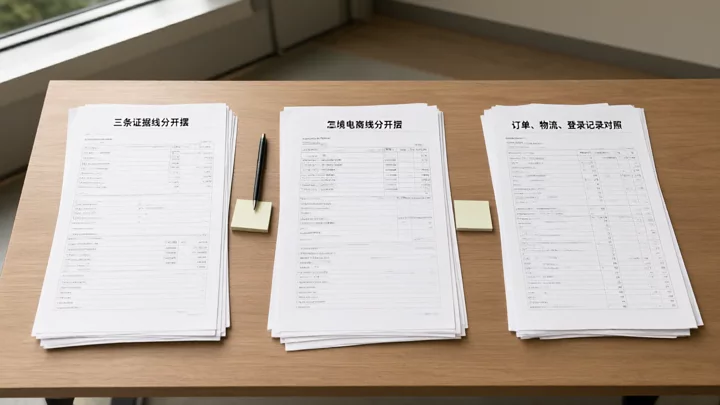
Translate every term in the notice into verifiable backend records, following three distinct lines.
- Performance Line:Map the metrics mentioned in the notice to specific orders and time windows, determine whether the anomaly was a sudden spike or long-term accumulation, and identify which SKUs and which carrier channels are involved.
- Fulfillment track:Pull the logistics tracking details for the orders in question, any carrier exceptions, communication logs with the buyers, and any corrective actions you’ve already taken.
- Environment track:Check for sub-account permission changes, logins from unfamiliar devices or networks, and whether any accounts belonging to recently separated staff members are still active.
Pages to preserve immediately include: the original notice (with system timestamp and full URL in the address bar), detailed metric pages, exported order-line details, logistics tracking screenshots, and backend operation logs plus sub-account permission changes. Screenshots must include timestamps, and exported tables must keep the original fields intact—do not pre-format them into a “prettier” version, or you will not be able to cross-check the terms cited in the notice later on.
Place all of these records in a single ledger so that appeals, claims, and post-mortem reviews can rely on the same dataset, ensuring standards do not conflict. For how to define the ledger fields, seeCross-Border E-Commerce Data Dashboard Tutorial: Complete Implementation Steps from Metric Standards to Visualizationsand refer to its approach of an order-level fact table.
Prepare a minimal evidence package according to the type of account suspension
| Suspension type | Required documentation | Entity-consistency requirements | Do not pile up materials |
|---|---|---|---|
| Performance-based | Screenshots of metric notifications, a list of the orders involved, logistics tracking and carrier anomaly proof, the submitted claim number, and the rectification plan | The store entity and business license can be matched with the payment account | Screenshots of historical excellent metrics unrelated to this case |
| Compliance/infringement-based | Complaint number, the listings and orders involved, power of attorney or purchase invoice, and takedown or destruction records | The company names on the authorization chain match the store entity | Authorization documents for other brands or other categories |
| Affiliation-based | Business license and legal representative identity, an explanation of the entity ownership of each account, screenshots of sub-account permissions, and an explanation of login devices and network usage | The entity relationships of multiple accounts can be matched one by one | Account List Without Any Explanations |
There are only three shared principles: materials must be independently verifiable by the platform, every document must have a timestamp, and each piece of evidence supports only one specific statement from the notification. The more you pile up, the harder it becomes to find the critical page.
Organize fulfillment exceptions into verifiable appeal evidence (using a lost parcel as an example)
In performance-based account suspensions, the most common points of contention are 'late shipment' and 'item not received,' and a lost parcel claim produces evidence for exactly these two items. The goal is not to include the compensation process in the appeal letter, but to turn the records kept at each step into attachments that correspond to the evidence.
- Order and tracking correspondence:Export order details from the platform backend and take screenshots of the carrier's official website tracking page. Focus on preserving two types of anomaly nodes—'picked up but no updates for a long time' and 'marked as delivered but buyer claims not received'.
- Claim reference numbers:After submitting a claim to the carrier or the platform's logistics channel, record the claim number, submission time, and the accepted ticket number. Verbal communication does not count; there must be a traceable reference number.
- Proof of value:Commercial invoices, declared value, and order screenshots are used to explain the basis for calculating losses for this specific order; compensation caps and deductible clauses are based on your contract with the carrier. Do not assume compensation amounts based on the order's selling price.
- Conclusion archiving:Save screenshots of the conclusion and reasoning, whether the outcome is full, partial, or rejected payment. A rejection is also useful, as it proves you proactively handled the exception rather than allowing order issues to accumulate.
In the appeal letter, one order corresponds to one claim number, indicating that the anomaly was outside the seller's control and that the claim process has been completed. If lost packages are concentrated on a specific channel or country route, it indicates an issue with the fulfillment structure; the rectification plan should specify channel adjustment solutions, which can be combined withHow to Choose Between FBA and Self-Ship: A Comparison and Decision Guide for Cross-Border E-Commerce Logistics Costs and Timelinessto evaluate whether to adjust the hybrid fulfillment ratio.
Appeal Letter and Submission Actions: State Only the Verifiable Fact Chain the Platform Can Confirm
- First paragraph addresses the specific clause:Clearly state which specific description in the notice you are addressing; do not start with a company introduction.
- Second paragraph presents the fact chain:List the time, order number, cause of anomaly, and actions taken in chronological order; ensure every statement can be verified in the backend.
- Third paragraph covers correction and prevention:Explain the adjustments already made, such as switching carriers or adding pre-shipment verification steps, and provide observable verification methods.
- Attachment numbers must match the body text:If the body text cites 'Attachment 3', item 3 must appear in the attachment list, named uniformly as 'Number_MaterialType_Date'.
- Single submission channel:Prioritize using the appeal portal specified in the notification. Do not submit the same content across multiple portals to avoid creating conflicting records.
- Do not include unverified content:Do not speculate about internal review logic. Avoid emotional expressions and do not use mass-email templates circulating online.
How to follow up after submission: 3—7—14-day timeline

Record the submission time, portal, and receipt number on the day of submission. On day 3, check whether an acceptance confirmation has been received; if no confirmation arrives, verify whether the submission was successful rather than immediately resending. If there is still no progress by day 7, you may submit a brief explanatory note to supplement new evidence, such as claim settlements or delay certificates issued by suppliers. Around day 14, reassess whether to switch to a manual channel or seek assistance from service providers.
There are several situations where repeatedly opening new tickets is not recommended: the rejection letter clearly points out missing materials but you have no new evidence; the same request is submitted in parallel through multiple portals; and repeating requests solely because the waiting time has exceeded expectations. These actions will not expedite the review and will instead create confusion over material versions. After the account is restored, execute each rectification action promised in the appeal letter and keep execution records; this is the step that prevents similar metrics from triggering again.
For explanations involving multi-shop permissions and entity ownership, refer toManaging Amazon Seller Accounts: Seller Central, Store Management Tools, and Multi-Account Operations Checklistand its four-layer mapping approach to clearly explain account entities, backend roles, login environments, and tool entries, respectively.
FAQ
Can I continue shipping or withdrawing funds during the appeal period?
It depends on the specific account restrictions stated in the notification. Do not rely on assumptions. If the notification is unclear, confirm via the appeal portal or customer support and keep screenshots of the replies. Do not treat operating as usual as the default option.
Will other stores under the same business license be affected?
Related-party determination usually involves multiple signals, such as entity information, login environment, and operational behavior. A single signal does not necessarily lead to action. If other stores receive performance reminders, prepare materials separately for each notification. Do not use a single letter to cover multiple stores.
My logistics loss claim is not yet closed. Can I submit the appeal first?
Yes. Submit the claim acceptance number and a screenshot of the current status, explaining that it is still in progress. Submit the final case closure as supplementary material afterward. Waiting for the case to close before appealing may cause you to miss the deadline specified in the notification.
How long after my first appeal is rejected should I wait before resubmitting?
Check whether the rejection letter points out missing materials. If it is just a template response and you have no new evidence, resubmitting the same content is not useful. Wait until you have gathered new evidence, then resubmit and clearly state in the first paragraph what has been added this time.