




The account fees for opening an Amazon store in 2026 are not high, but once you truly start operating, you also need to factor in costs for product sourcing, logistics, FBA, advertising, returns, and more.
The overall startup capital varies greatly depending on the product and operating model.
I. How Much Does an Amazon Seller Account Cost Per Month?
Taking the U.S. marketplace as an example, as of 2026, Amazon primarily offers two selling plans:
Both plans may incur additional fees such as referral fees.
If you simply want to test a few products at a low cost, start by looking into the Individual plan. If you plan to operate long-term, run ad campaigns, or scale up sales, the Professional plan is usually the one worth focusing on.
The 39.99 USD is just the monthly account-level fee and does not represent the full cost of opening a store.
Section Two: How Are Amazon Referral Fees Calculated?
Beyond the monthly fee, the referral fee is the most critical cost sellers need to pay attention to.
When you sell an item, Amazon deducts a percentage of the sales revenue according to its corresponding rules.
The rates vary across different product categories. For example, referral fees may differ for categories such as clothing, home goods, electronics, and beauty.
It is not accurate to simply say 'Amazon charges a flat 10%.' If you are planning to work in a specific category, it is best to check the fee schedule on the relevant marketplace directly and factor the referral fee into your profit calculations.
Does Opening an Amazon Store Require a Security Deposit?
Many beginners ask, 'Do I also need to pay a large security deposit to open an Amazon store?'
This question cannot be answered with a simple 'yes' or 'no.' Different marketplaces, business types, product categories, and specific account situations may have different requirements. Amazon may also require sellers to provide additional documentation or meet certain conditions based on their specific circumstances.
For specifics, please refer to the registration page and Amazon's current official policies. It is not advisable to see a seller online claim that "you must pay a deposit of X ten-thousand yuan" and then directly apply that figure to your own store.
IV. If a product sells for $100, do you actually receive $100?
Of course not. Let's assume a product is priced at $100: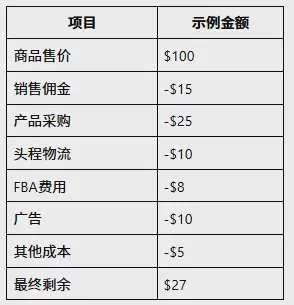
Note: The $27 here is purely for illustrative calculation purposes and does not mean that Amazon sellers can actually earn a 27% net profit.
Actual profits are also influenced by factors such as product category, logistics, advertising, returns, warehousing, and taxes.
Running an Amazon business should not focus solely on "how much this product sells for," but rather on "how much is actually left after it sells."
V. Product Sourcing Costs
If you choose physical products, after opening your store you will typically face the first significant capital outlay:Inventory procurement.
Sourcing costs include not only the product itself but also items such as packaging, labels, cartons, sampling, quality inspection, customization, and domestic shipping.
Beginners should not assume that a few dozen dollars is all it takes to get a business off the ground, just because they see that "opening an Amazon store costs only a few dozen dollars."
Account costs and operating costs must be calculated separately.
Six, First-Mile Logistics + FBA Fees
If you choose the FBA model, at least two segments of logistics costs need to be accounted for between the supplier and the consumer:First-mile logistics + FBA fulfillment fees.
First-Mile Logistics
Products must first be transported from the supplier's location to the Amazon warehouse. Common methods include ocean freight, air freight, express delivery, and rail.
The actual cost depends on factors such as product weight, volume, shipment quantity, shipping method, and whether it is peak or off-peak season.
FBA Fees
FBA is a model in which sellers send their products to Amazon warehouses in advance, and Amazon handles logistics processes such as storage, picking, packing, and delivery.
Common costs include delivery fees, storage fees, long-term storage-related fees, and return processing fees, among others.
Amazon also offers an official Revenue Calculator that helps sellers estimate the sales, FBA, and fulfillment costs for specific products.
What beginners tend to overlook is:A product not selling doesn't mean there are no costs.
Goods sitting in a warehouse can still incur storage-related fees.
So when selecting products, you can't just consider "will it sell?"—you also need to think about "what happens if it doesn't?".
VII. Advertising and Return Costs
Advertising
When a new product first launches, it has no organic ranking or reviews, so many sellers turn to advertising to gain initial visibility.
Ad costs depend on product competition, keyword competition, conversion rate, and profit margin.
You can't simply set a rule that "advertising must be 10% of sales revenue."
A more reasonable approach is:First, set an affordable ad budget based on your profit margin, then adjust based on actual performance data.
Returns
After a consumer places an order, situations such as returns, damaged goods, or items that cannot be resold may arise.
This is especially noticeable in categories such as clothing and footwear. When building your profit model, it is best to budget for a certain amount of return costs.
VIII. How Much Do Software Tools Cost?
During operations, you may use keyword tools, product selection tools, competitor analysis tools, ERP systems, and more.
Pricing varies greatly across tools. Some offer free versions, while others charge on a monthly basis.
When you are just starting out, it is not recommended to purchase a large number of tools all at once.
First identify the problems you actually need to solve, then choose your tools.
IX. Budgeting Approaches for Different Operating Models

So there is no single answer to the question "What is the minimum cost to open an Amazon store?" What truly determines your startup capital is your product and operating model.
We don't recommend giving a fixed answer like "$500 to open a store" or "$3000 to run on Amazon" here, because procurement prices, minimum order quantities, logistics methods, and ad competition vary enormously across different products.
Ten. Will costs increase after scaling to multiple stores?
If you gradually grow from one store to multiple stores, what increases isn't just the number of accounts.
It can also increase costs for operations staff, account management, customer service, ERP, data analytics, inventory management, login environment management, team permission management, and more.
Especially once multiple team members are managing multiple stores simultaneously,environment management and permission managementwill gradually become new operational costs.
For example, if a team is managing multiple Amazon stores and everyone uses a regular Chrome Profile, as more local environments accumulate, issues like "Which store does this Profile actually belong to?" or "How do I migrate my environment to a new computer?" are likely to arise.
Tools like P1 Browser and similar environment management tools can create isolated browser environments for different business accounts, support assigning permissions by member and categorizing by store, and help teams manage multiple operational environments more efficiently.
Eleven. The 5 Most Common Pitfalls
Pitfall 1: Treating the $39.99 as the total cost of opening a store
The US site also has an Individual plan, and sales commissions, FBA, advertising, etc. are additional costs on top of that.
Pitfall 2: Only calculating procurement costs
Between the supplier and the consumer, there are still costs for logistics, platform fees, advertising, and more.
Pitfall 3: Ignoring inventory
Products that fail to sell can still incur storage costs.
Pitfall 4: No cap on the advertising budget
Spending more on ads is not necessarily better; budgets need to be controlled based on profit and conversion data.
Pitfall 5: Buying a large amount of software upfront
New sellers easily buy a pile of tools for "professional operations," only to end up actually using just one or two.
Summary
The account fee for opening an Amazon store is not high. What truly needs to be prepared is the working capital for ongoing operations.
If you're planning to sell on Amazon, don't just ask "How much does it cost to open a store?" You should first figure out:"How much total capital do I need, from sourcing my products all the way to ultimately generating profit?"
That is the budget that actually matters.
If you're evaluating the budget for opening an Amazon store, a good starting point is understanding the registration process and fee structure.
Frequently Asked Questions (FAQ)
How much does it cost to open an Amazon store?
If you're only accounting for the US marketplace seller account, the Individual plan charges per item sold, and the Professional plan costs $39.99/month as of 2026. But running an Amazon business in practice also involves product, logistics, FBA, advertising, and return-related costs.
What is the difference between an Individual seller and a Professional seller on Amazon?
The Individual plan charges $0.99 per item sold, which suits sellers with lower monthly sales volume; the Professional plan has a monthly fee of $39.99 as of 2026, which suits sellers who sell 40 or more items per month or need professional features such as advertising and bulk listing. Both plans may also incur referral fees and other charges.
What is the minimum amount of money needed to open an Amazon store?
If you're only considering the US marketplace seller account, the Individual plan charges per item sold, and the Professional plan costs $39.99/month as of 2026. But if you actually start selling, you'll also need to set aside funds for products, logistics, advertising, working capital, and other expenses—so there is no single "minimum startup capital" that applies to all sellers.
What is Amazon's referral fee?
Sales commissions are calculated based on factors such as the product category. Rates vary across different categories, so you should check the current official fee schedule for the relevant marketplace.
Is Amazon FBA expensive?
FBA fees depend on factors such as product size, weight, storage duration, and shipping. Products that are bulky, heavy, or have slow inventory turnover require special attention to FBA-related costs.
How much does Amazon advertising cost per month?
There is no universal standard. Advertising budgets mainly depend on product competition, profit margins, keyword competitiveness, and the seller's operational strategy. New products typically require a certain amount of testing budget.