


Three TikTok Shop accounts under the same supplier triggered abnormal login alerts in sequence within 48 hours, yet all tool logs showed green. This is not a platform malfunction—it is a silent failure at one layer of the isolation stack. The primary trigger in TikTok Shop multi-account operations is cross-platform composite signals—shared outbound IP, overlapping operation timestamps, tool data aggregation—rather than single-platform internal settings. The following breaks this down layer by layer in a "Diagnosis → Attribution → Remediation" framework.
Amazon's official guidance also notes that a policy issue on one account may affect related accounts (Amazon Multi-Seller Account Health Notice). The diagnostic order is fixed at five layers: network outbound → login credentials → payment entity → operation timing → tool data. If any single layer is not isolated, the remaining four layers—despite appearing normal—will cascade into failure. When the same batch of devices simultaneously operates TikTok Shop, Shopify standalone stores, and eBay Seller Hub, cross-platform signals are far more likely to trigger risk controls than single-platform settings.
Registration to Activation: Four Delayed-Trigger Pitfalls
- Entity type locks in downstream platform eligibility.Individual entities can register on TikTok Shop and Shopee, but Amazon and eBay U.S. sites require corporate entities. Before registration, cross-referenceQualification Checklist for Individuals in Cross-Border E-CommerceConfirm the entity to avoid having to start over when expanding to a new platform in Week 6.
- Registration IPs in the same batch are not separated.The same outbound IP registered more than 3 accounts within 72 hours; the probability of abnormal logins rises from Week 4 onward. Same-day fix: Use a dedicated proxy outbound for each account to complete registration and first login.
- No basic isolation of device fingerprints.Two TikTok Shop Seller Centers logged in simultaneously in the same browser; cookie domains are isolated but JS fingerprints overlap. Same-day fix: Use separate browser profiles and disable hardware fingerprint sync plugins.
- Payout entity has not been bound at the account level.Multiple accounts share the same corporate card or PayPal; payment signals aggregate during reconciliation in Months 2–3. Same-day fix: Bind an independent payout account to each account; refer to the operating guidelines inCross-Border E-Commerce Operations Tool Guide.
Multi-Account Isolation Ownership: Four-Layer Boundary Reference Table
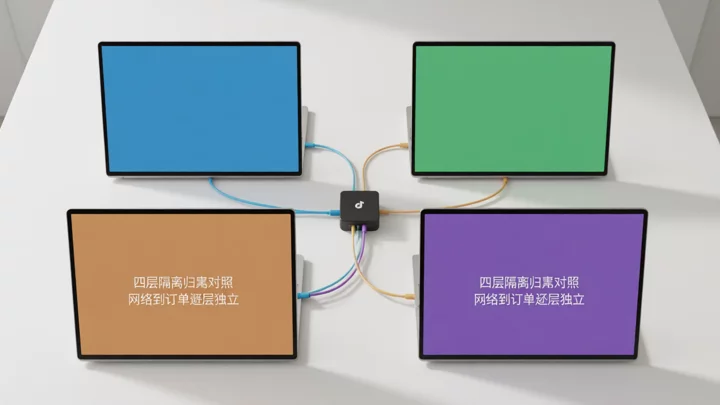
| Isolation layer | Attribution criteria | 2-store threshold | 5+ store threshold |
|---|---|---|---|
| Network egress | Dedicated IP range per account; no switching when TTL≥7 days | Manual switching is acceptable | Automatic tool routing |
| Login credentials | Dedicated browser profile per account; shared Cookies disabled | Permitted on the same device | Dedicated hardware or virtual machine |
| Inventory synchronization | Write access is assigned to a single system; all others are read-only | Scheduled synchronization ≥30min | Real-time synchronization within a ≤5min window |
| Order routing | Pre-set allocation rules; manual cross-store order transfer is prohibited | Manual confirmation is sufficient | Automatic routing + rollback mechanism |
When TikTok Shop multi-account stores alongside Amazon Seller Central, Shopify standalone stores, and eBay Seller Hub all receive orders simultaneously, cross-platform tools are tiered by store count × SKU complexity: 2 stores × up to 200 SKUs can use spreadsheets + scheduled synchronization; 5 stores × 800 SKUs must switch to system-level tools. Selection logic is referenced inTikTok Shop, Shopify, and eBay Store Management Tools Compared.
From Listing to First Order Fulfillment: Four Operational Breakpoints and Same-Day Fixes

- Inventory sync delay window.When the same SKU is sold on both TikTok Shop and a Shopify standalone store, overselling is triggered within the 40min sync delay. Fix: inventory buffer = daily sales peak × sync window (40min), manually deducted in the TikTok Shop Seller Center.
- Pricing write-permission direction conflict.The two systems write in opposite directions, so the later write overwrites the earlier value. Fix: designate TikTok Shop as the primary writer, Shopify follows in read-only mode, and lock the write direction in the tool.
- Unpreconfigured order routing triggers cascading session logouts.Orders without preconfigured routes trigger cross-store transfers, causing frequent session switches. Fix: pre-configure route tables by platform × region, prohibit manual cross-store transfers; operational details inMulti-Platform Seller Account Efficient Operations Guide.
- Logistics delivery-time commitment breakdown.The fulfillment time entered at listing was not back-calculated from actual logistics capability, triggering SLA penalties on the first order. Fix: based onthe AOV threshold to back-calculate available logistics, and verify that the timeframe is achievable before listing.
FAQ
Do multiple TikTok Shop accounts require different company entities?
Not necessarily. Multiple TikTok Shop accounts under the same entity are permitted within platform rules, but the four-layer isolation described above must be applied. If Amazon seller accounts are also being operated, cross-platform entity overlap is a high-risk signal; entity separation at the payment layer is recommended at a minimum.
Can two TikTok Shop accounts be linked to the same TikTok Business Center?
It is feasible at the ad-asset level, but Seller Center operations must use separate logins; otherwise, session signals will aggregate. TikTok officially recommends managing access through roles and permissions and avoiding shared credentials (Business Center Role Documentation).
Is the 40-minute inventory sync delay a fixed value?
No. 40 minutes is the default polling window on the tool side; the actual value depends on the sync frequency of the selected tool. For 5 or more stores, the window should be ≤5 minutes, otherwise the buffer quantity must be recalculated based on the actual window.

