

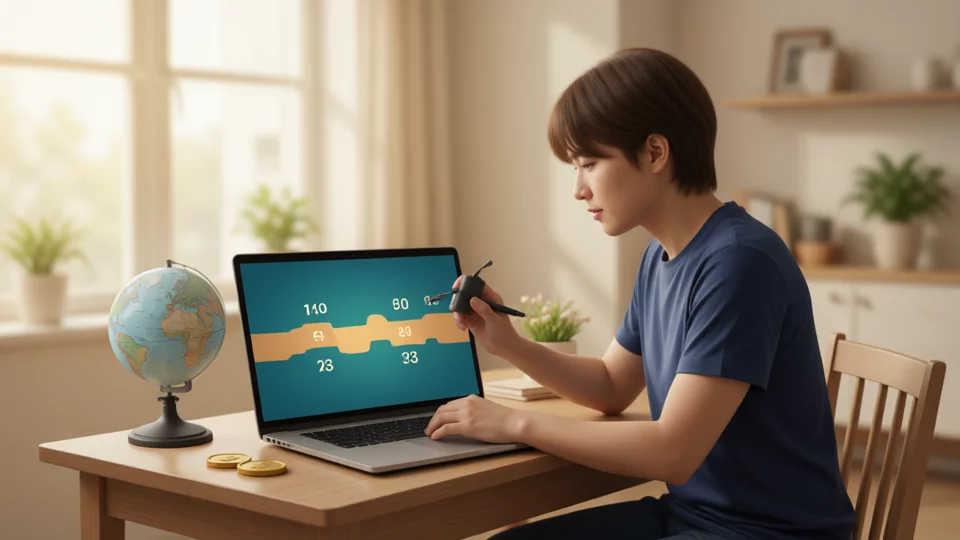
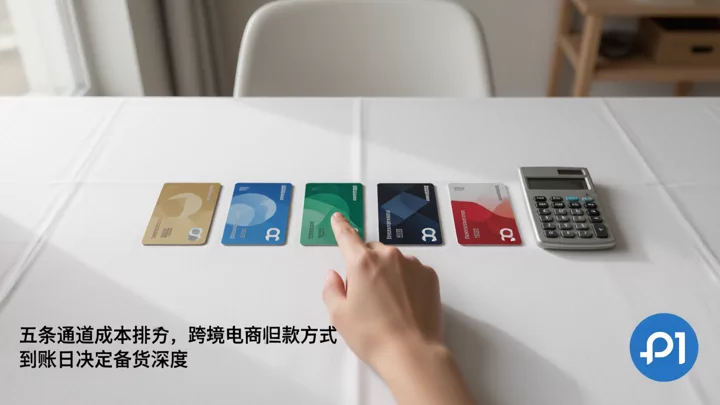
Beyond PayPal and Payoneer, cross-border e-commerce payment methods suitable for small and medium-sized sellers also include Alipay Cross-Border, PingPong, Airwallex (空中云汇), 万里汇 (WorldFirst), and bank wire transfers plus overseas local accounts—five supplementary channels in total. A seller running both Amazon FBA and TikTok Shop has monthly payouts split into two installments in different currencies with different settlement dates. FBA restocking funds are always 7 days late in arriving, forcing the seller to resort to expensive air freight and adding three-tenths to per-shipment logistics costs. The problem is not the logistics provider's quote, but that the payment settlement rhythm does not match the depth of inventory preparation. Choosing a payment method is, at its core, choosing a fund availability date—not choosing a brand name.
Fee Structure and Settlement Cycle: Two Variables to Check Before the Brand Name
For small and medium teams with monthly volumes of 5 to 50 (in ten-thousands), the comparison should be narrowed to two dimensions: total cost per transaction (FX spread + withdrawal fee + fund holding fee) and fund availability date (T+n). Even if a channel has high brand recognition, if it releases funds only at T+7 and charges holding fees on a daily basis, it becomes a hidden loss for sea-freight routes that require 45 days of advance stocking. Calculating these two numbers first, then deciding which channel to use, is far more effective than dwelling on "PayPal or Payoneer."
5 Payment Channels Beyond PayPal and Payoneer
| Channel | Supported Platforms | Supported Currencies | Typical credit | Monthly holding threshold |
|---|---|---|---|---|
| Alipay Cross-border | Shopee, Lazada, 1688 Cross-border | CNY, USD, EUR, MYR, THB, etc. | T+0 to T+1 | No minimum top-up; transaction-based fees |
| PingPong | Amazon, eBay, Etsy, TikTok Shop | USD, EUR, GBP, AUD, CNY | T+1 to T+2 | 0 CNY account opening; tiered withdrawal fees |
| Airwallex | Amazon, Shopify, independent stores, multi-platform aggregation | 150+ currencies, 8 core currency pairs | T+0 to T+1 (instant for local accounts) | Business entity, low-tier rate at 5 ten-thousand USD monthly volume |
| WorldFirst | Amazon, eBay, Shopee, TikTok Shop | USD, EUR, GBP, HKD, CNY | T+1 | Business entity, no monthly fee, withdrawal fees from 0.5% |
| Bank wire transfer + overseas local accounts | Any B2B, independent store, or enterprise client | USD, EUR, GBP | T+2 to T+4 | Requires a corporate account; single wire transfer fee: USD 20–50 |
The common traits across all five channels are: predictable credit dates, transparent holding fees, and multi-currency consolidation support. Which one to choose depends on your primary platform's payout currency and your inventory cycle, not "which brand is bigger."
Composite cost comparison per ten thousand USD in transactions across channels
When you combine the FX spread, withdrawal fees, and 30-day capital holding interest, the composite fee rate difference across the six channels ranges from approximately 0.8 to 3.2 percentage points. The bar chart is arranged by relative index (illustrative of relative metrics, not representing actual statistics); higher values indicate higher composite cost:
PayPal, with its 3.49% transaction fee plus a 3.5% FX spread compounding, has the highest composite cost among the six options; PingPong and WorldFirst show the most pronounced advantage in the low-to-mid monthly volume range (within 10 ten-thousand USD per month). Once monthly volume exceeds 50 ten-thousand USD, the fixed per-transaction cost of bank wire transfers is diluted, and the composite index actually drops.
Match the receiving method to your platform combination and monthly transaction volume
- Monthly volume <10 ten-thousand (CNY):Choose low-barrier, instant-settlement channels. Alipay Cross-Border or PingPong waive account-opening fees and release funds on T+1, making them ideal for high-frequency, small-amount payout scenarios on platforms such as Shopee and TikTok Shop. Funds are available the same day, so restocking decisions never have to wait.
- Monthly transaction volume of 10–50 wan:Use a "multi-currency account + bulk withdrawal" combination. Open dual-currency local accounts in USD and EUR with Airwallex or WorldFirst, then consolidate FX settlement to your corporate account at month-end to minimize per-transaction FX loss. If you run both Amazon and your own website, split into two receiving accounts by payment entity to avoid reconciliation problems caused by mixed funds.
- Monthly transaction volume above 50 ten-thousand, or requiring USD/EUR local collection:Use bank wire transfers + overseas local accounts. The per-transaction wire fee of 20–50 USD becomes negligible at volume, and T+2 to T+4 settlement can be fully factored into a 45-day ocean-freight restocking schedule.
When selecting 2–3 initial platforms, first confirm each platform's payout currency and settlement cycle, then work backward to determine the receiving channel. For extended reading on channel-selection logic, seeWhat cross-border e-commerce platforms are there? Channel selection logic from Amazon to TikTok Shop, align your platform matrix and cash-flow paths in one pass.
Settlement cycle: the core quantitative criterion for SMB sellers evaluating receiving methods
The settlement cycle (T+0 to T+7) directly determines the funds-available date, which in turn affects safety-stock days and logistics mode. T+0 settlement means funds are available the same day, so you can plan restocking around a 45-day ocean-freight cycle at the lowest per-unit logistics cost; T+3 settlement requires stretching safety stock from 7 to 12 days, compressing the ocean-freight window. For FBA sellers, if your primary channel releases funds at T+2, restocking safety stock should include at least a 10-day buffer—otherwise the probability of stockouts during peak season rises significantly. Therefore, when choosing a receiving channel, SMB sellers should treat "funds-available date" as the first screening criterion, then match it against the monthly-volume tier discussed above to lock in the specific channel.
Registered Entity and Compliance Red Lines: What Accounts You Can Open
Hard Constraints on Entity Type:Airwallex, WorldFirst, and bank wire transfers all require a corporate entity (limited company or sole proprietorship); Alipay Cross-Border and PingPong support individual identities but with withdrawal limits. If you currently operate as an individual, start by cross-referencingWhat You Need to Do Cross-Border E-Commerce as an Individual: A Complete Starter's Checklist for Qualifications, Funding, and Logisticsto identify any qualification gaps. For the full path from entity registration to store setup, seeFrom Entity Registration to First Order Shipment: A Five-Step Practical Guide to Opening a Cross-Border E-Commerce Store.
Tax Filing:Regardless of which channel you use, cross-border income must be included in your annual individual income tax or corporate income tax filing. Since 2024, most platforms have integrated with the State Taxation Administration's data systems, and the risk of back-tax recovery for unfiled income increases each year. Before opening a new account, confirm that your entity's tax registration number is active.
Frequently Asked Questions
Can I open Airwallex or WorldFirst with an individual identity?
No. Both channels require a business license and Unified Social Credit Code during the KYC process. Individual identities can opt for Alipay Cross-Border or PingPong, but the monthly withdrawal cap is typically 20 wan CNY, and exceeding this transaction volume requires upgrading to a corporate entity.
Will using two payment channels simultaneously across multiple platforms cause fund confusion?
Yes. If Amazon routes through PingPong and TikTok Shop routes through Alipay Cross-border, the two payouts land in different currency accounts, and reconciliation requires manual matching of order numbers. We recommend splitting along the principle of “one platform entity maps to one receiving account.” For multi-platform management tools, refer toAre Cross-Border E-Commerce Seller Accounts a Mess? From eBay to Temu, Manage 10 Platforms with a Single Store Management Toolthe ownership allocation method in that tool.
Can a T+7 settlement channel work alongside sea-freight stocking?
It can, but safety-stock days will need to extend from 7 to 14 days, raising total holding costs by approximately 20%. If monthly turnover is stable and the platform settlement cycle is fixed, you can slot T+7 into the countdown of a 45-day sea-freight schedule, and it remains feasible. However, if peak-season order volume doubles, we recommend switching to a T+1 channel to reduce buffer days.
After switching the receiving method to a corporate entity, does the old personal channel need to be closed?
There is no mandatory requirement to close it, but we recommend withdrawing the full balance from the old channel and deactivating it to avoid cross-contamination between the two pipelines during reconciliation. Before deactivation, confirm that the receiving-account binding in the platform dashboard has been switched, so new orders do not still route through the old channel.