



Conclusion first:Domains can be shared, but it depends on whether you are operating multiple brands; payments should be separated by business license entity as much as possible; the logistics backend can be shared, but return addresses and shipping label identifiers must be distinguished by store.Lumping these three parts together when discussing "whether to isolate them" will only yield an answer that is either separate everything or share everything, and that answer applies to neither case.
The breakdown below follows three layers: the external brand layer (domains), the funding entity layer (payments), and the fulfillment chain layer (logistics). First determine whether these three layers overlap across stores, then decide whether to separate or share.
Baseline judgment:Sharing domains sacrifices brand and advertising data, so it can be separated later; sharing payments involves the entity and payment review, so it must be sorted out first; the cost of sharing logistics mainly falls on customer experience. Sharing does not mean inevitable association, and independence does not mean absolute security—both merely reduce the overlap of a single signal.
Which Part to Isolate First: Risks and Adjustment Costs of Sharing All Three
If at this stage you only have the energy and budget to do one thing, start with the payment entity. The reason is not that it is "the most dangerous," but that its adjustment cost is the highest: changing the receiving account means re-signing contracts, re-verifying, and reconciling again, and it may also affect the settlement cycle along the way. The cost of changing the domain is 301 redirects and ad link checks; shipping rate templates are the cheapest to change.
Domains: What stage are standalone domains, subdomains, and multiple stores on the same domain each suitable for?
The three options are not a matter of better or worse, but of stage. You only need to answer one question: do these stores look like the same brand to customers?
| Option | Suitable stage | Brand and ad tracking | Main costs |
|---|---|---|---|
| Independent domains | Different brands, different customer segments, prepared for long-term investment | Brand, pixels, and SEO fully independent | Each domain accumulates authority and trust separately |
| Subdomain (a.example.com) | Product lines or test lines under the same brand | Shared brand, analytics tools can be configured separately | Customers can tell it's the same company |
| Same domain, different paths | Complementary categories, overlapping customer segments, no concern about brand confusion | Pixel and conversion data can easily become mixed together | Migration costs are the highest, and splitting requires redoing redirects and creatives |
The decision criteria come down to two points: ad tracking and migration costs. Multiple stores on the same domain will mix together Meta and Google pixel and conversion data; unless you use separate pixels and clear path parameter isolation, it is difficult to tell which product line is making money. Subdomains are a compromise: SEO authority is relatively independent, but customers still know it is the same company. For different brands, different customer groups, and long-term plans, go directly to independent domains; splitting later will only pile up more changes to redirects, backlinks, and ad creatives

Payments: what can be shared and what must be separated by entity
The unit of judgment for payments is the business license entity, not the store. Multiple stores under the same entity and stores under different entities follow completely different rules
- Multiple stores under the same business license and the same legal representative:Third-party payment collection can usually be evaluated for sharing a main account, but it is recommended to open sub-accounts or separate payment IDs per store; otherwise, when reconciling, refunding, and appealing, you cannot tell which funds belong to which store
- Shopify Payments:Reviewed by the payment service provider based on the store and entity; whether it is approved depends on qualifications and business type. Do not assume that if the first store is approved, the second will automatically be approved. For specific rules, refer to the Shopify official help center and your payment service provider's policy shall prevail.
- PayPal:For multiple stores, aim for one account per store, and do not repeatedly switch logins within the same browser environment. The payer, refund records, and dispute rate are all tied to the account; mixing them will concentrate abnormal billing into a single account.
- Different legal entities, different business licenses:Must be kept separate; the payment collection entity must match the store entity, and these stores should not share bank accounts or payment collection accounts.
The common pitfall is treating “can be used” as “should be used.” Sharing a primary payment collection account saves account-opening time, but the cost is confusion in fund aggregation standards: once a store has a disputed order, it is difficult for you to prove that the funds of the other stores belong to independent businesses unrelated to it.
Logistics: the backend can be shared, but the customer-facing parts must be separated.
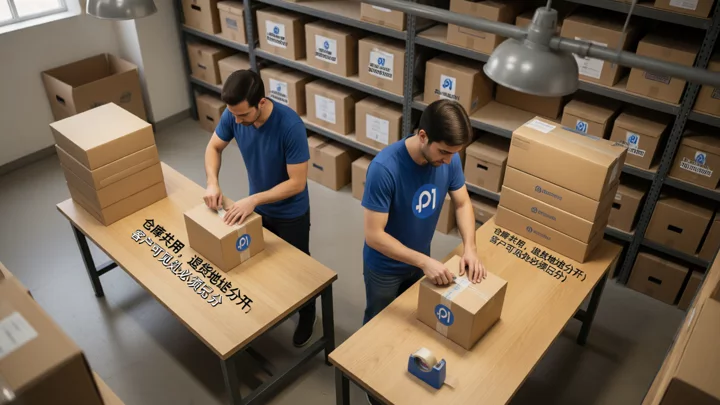
The dividing line for logistics is simple: whether customers can see it. Sharing warehouses, pickup addresses, and logistics service provider backends is imperceptible to customers and does not affect fulfillment; return addresses, label markings, and shipping fee templates are directly customer-facing, so sharing them will expose flaws.
- Can be shared:The same warehouse shipping address, the same logistics service provider backend, the same pickup point, and the same first-leg channel.
- Must be differentiated by store:Return address (at least the store name should appear in the recipient field), the store or brand identifier on the shipping label, the shipping fee template (weight tiers and free-shipping thresholds differ by category), and the customer service email for logistics exceptions.
- Trade-off criteria:When cost and experience conflict, prioritize experience. The discount obtained from sharing a logistics account usually does not outweigh the loss of trust when buyers see another store's return address.
Store binding table: put domains, entities, payment collection, and logistics into one table.
Problems with multiple stores usually do not arise because too many stores are opened, but because a certain layer is shared without anyone recording it. Before opening a store, first create a table; add a row for each store opened.
| Field | Content to fill in | Overlap tolerance |
|---|---|---|
| Store code / domain | Primary domain, subdomain, or path | Can overlap; brand ownership must be recorded. |
| Business license entity | Company name, Unified Social Credit Code | Different entities must not share a collection account |
| Collection account | Shopify Payments, PayPal, third-party sub-account ID | The same entity may share the main account, but sub-accounts must be separated |
| Shipping address | Warehouse address and contact person | Can be shared |
| Return address | Set separately for each store | Sharing is not recommended |
| Shipping templates / label identifiers | Set by store and category | Sharing customer-visible parts is not recommended |
Make a note of the two threshold tiers.Acceptable overlaps:Warehouse addresses, logistics service provider backends, and the same returns processing workflow.Overlaps that amplify risk:Stores under different entities sharing one receiving account, and a return address that is inconsistent with the store brand. The latter category needs to be resolved before opening the store, not patched up after operations begin.
Frequently Asked Questions
Can the same domain be bound to multiple Shopify stores?
A store can have only one primary domain, and multiple stores cannot share the same primary domain. In practice, different subdomains are usually used to point to different stores, or independent domains are purchased directly. Subdomains are technically feasible, but brand, SEO, and advertising data will be mixed together, so they are only suitable for complementary categories under the same customer group.
Under the same business license, can multiple stores share payment collection?
You can evaluate sharing a primary third-party payment collection account, but sub-accounts or independent payment IDs must be opened per store to ensure reconciliation and refunds can be traced back to the specific store. Shopify Payments and PayPal are contracted and reviewed separately by store; do not assume that if one store passes review, the others will automatically pass.
Will sharing a logistics account be deemed linked?
Logistics accounts are fulfillment tools, not platform-side store identity identifiers; sharing itself does not constitute a linkage determination. What really needs to be differentiated are the customer-visible elements: return address, shipping label branding, and shipping rate templates.