



Your independent site is deployed, the first ad-driven order just came in, but your receiving account is still stuck in KYC review and your business license scope doesn't cover "cross-border e-commerce retail export"—the order goes silent for 48 hours with no funds coming through. This type of "launch-day failure" is not a low-probability event; it is the inevitable result of three variables—site-building tool, payment pathway, and entity compliance—failing to be aligned in advance.
There are hard dependencies among the three variables: the tool determines which payment gateway you can connect to, the gateway determines which clearing entity the funds flow through, and the entity in turn locks in the license scope and customs filing method. If any link lags, it will surface on launch day. Below, each variable's decision criteria and completion checkpoint are broken down by dependency rather than as a fixed sequential procedure.
Launch-Day Stress Test: Three Variables Must Be Alined in Advance
Treat "launch day" as a stress test and work backward: on that day you must simultaneously have three things—a storefront that can process payments normally, a complete fund-repatriation chain from overseas buyer to domestic account, and an entity verification document whose business scope covers the target export model. Missing any one of these, the ad budget is just burning.
Many sellers default to a serial rhythm of "build the site first, then get the license, finally integrate payments," which means the license issuance cycle (typically 15–30 working days) becomes the launch bottleneck. The correct approach is to kick off three things in parallel during the product-selection phase: confirm entity type and schedule a business registration name check, select a site-building tool for the target market and test the payment plugin, and simultaneously initiate KYC review for the payment-receiving channel. With three tracks running in parallel, any bottleneck can be spotted two weeks early.
How to Choose a Site-Building Tool: Match the Payment Pathway, Not Feature Count
The underlying constraint in tool selection isn't "how many features it has" but "which payment gateway it supports." Applicable boundaries for the three mainstream routes:
- Shopify: Average order value of USD 30 or above, SKU count kept within 200, target market North America/Europe. Natively supports Stripe and PayPal gateways, with a mature plugin ecosystem, making it ideal for 1–3 person teams to launch quickly. However, accessing the admin dashboard from China-based IPs triggers rate limits, which requires pairing witha multi-platform operational environmentfor network isolation.
- Shoplazza / Youzan Cross-Border: Average order value of CNY 50 or above, SKU range of 500–2000, requiring a domestic team available 7×12 hours. Natively integrates with domestic compliant settlement channels such as PingPong and Airwallex, eliminating the need to open cross-border bank accounts, though overseas SEO authority accumulates more slowly than Shopify.
- WooCommerce (Self-hosted):SKU count exceeding 2000, available development resources, and a need for deep customization. Offers the highest payment gateway flexibility but also the highest maintenance cost, suitable for small teams with stable monthly revenue exceeding 50 wan and at least 2 technical staff.
Two hard metrics to confirm during the product selection stage: dominant payment preferences in the target market (which determine gateway priority) and the expected SKU growth curve (which determines the tool ceiling). If you are still in the product selection stage, it is recommended to first reviewthe Product Selection Triangle Assessment Frameworkto lock in the category, then work backward to determine the tool tier; for channel-level trade-offs, refer tothe Platform Selection Logic.
Payment & Collection: Full-Chain Configuration from Gateway to Fund Settlement
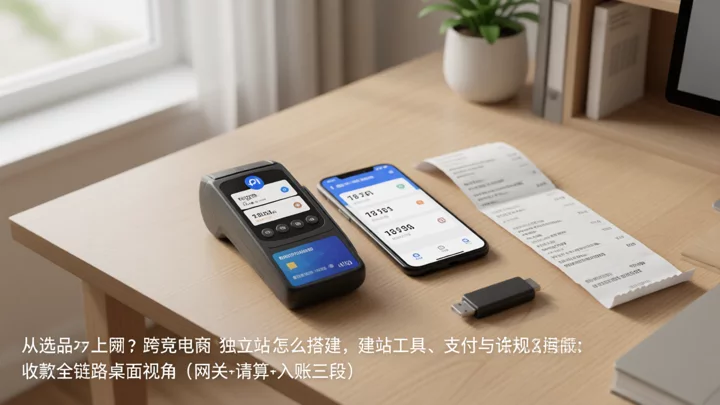
The collection chain is divided into three segments: front-end acquiring (Stripe / PayPal / local gateway) → intermediate clearing (PingPong / Airwallex / Alipay Cross-Border) → domestic settlement (corporate or sole proprietorship account). For small and medium sellers (monthly transaction volume of 5 ten-thousand to 50 ten-thousand), the most common bottleneck is not the gateway itself but the intermediate clearing stage: KYC review cycles, matching of settlement currency to declaration numbers, and the T+1 to T+7 settlement cadence.
- North American Market: Stripe (acquiring) + PingPong USD account (clearing) + corporate account (settlement), with a combined fee of approximately 3.4%–4.2% and funds received in 2–5 business days.
- European Market: PayPal (backup) + Airwallex EUR account (primary clearing) + sole proprietorship or corporate account; SEPA transfers require a linked IBAN, otherwise the return rate increases significantly.
- Multi-Market: Alipay Cross-Border + currency-based inventory splitting to avoid FX lock-in risk from a single clearing entity.
For a more detailed comparison of gateway fee structures and settlement cycles, refer toBeyond the breakdown of PayPal and Payoneer payment collection methods.
Compliance and Business License: Key Points on How to Obtain a Cross-Border E-Commerce Business License

Processing order and estimated timeline (from appointment to full completion, typically 20–35 days):
- Business Name Verification and Registration (5–7 days):Either a sole proprietorship or a company is acceptable, but the business scope must include the wording "cross-border e-commerce retail export" or "import and export trade." The 9810 model requires the registered entity to be a general taxpayer or a sole proprietorship; small-scale taxpayers must first complete tax registration before filing.
- Customs Filing (7–10 days):Bring your business license to the local customs office to file the "Registration of Import and Export Goods Consignor/Consignee," and simultaneously register with the China Electronic Port to obtain the legal representative card and enterprise card. The 9810 model additionally requires enabling cross-border e-commerce retail export filing authority in the customs system.
- Forex and Tax Registration (3–5 days):Go to your account-opening bank to open a foreign currency account (USD/EUR), and select the "export tax rebate" or "cross-border e-commerce tax exemption" filing type on the Electronic Tax Bureau. Sole proprietorships select tax exemption; companies select tax rebate.
Before the business license is officially issued, you can complete website setup and submit KYC to your payment gateway (some channels allow a "review first, supplement later" process), but the first payout must be credited to the registered entity; otherwise, the foreign exchange authority will flag it as an abnormal settlement. For the complete store-opening path, refer toThe Five-Step Practical Path from Entity Registration to First-Order Fulfillment.
Frequently Asked Questions
When your independent site and platform stores both generate orders, how do you handle inventory synchronization to avoid overselling?
The core is not about how many back-end tools you install, but about clearly defining write ownership across three sync lines: inventory, pricing, and order routing. The platform side (e.g., Amazon FBA) and the independent site each maintain their own inventory figures. Use a scheduled sync job (interval no longer than 15 minutes) to pull in-transit platform inventory and deduct it from the independent site's available quantity, compressing the oversell risk window to under 15 minutes.
The license hasn't been issued yet—can I set up the site and start running ads first?
Website setup and ad account registration do not depend on the license and can be completed first. However, when submitting KYC for a payment gateway, you are typically required to upload a business license or equivalent entity documentation. Without a license, the channel will remain in a "pending review" status and cannot process actual payouts. We recommend proceeding with website setup and advertising in parallel, and activating the payment channel within 48 hours of license issuance.
When collecting payments in multiple currencies, at which step should you lock the exchange rate?
Lock the rate at the mid-stream settlement stage, not at the front-end checkout stage. Keep front-end checkout in the original currency (USD orders go through Stripe in USD, EUR orders go through Airwallex in EUR), and settle into a RMB account at the day's mid-market rate during the settlement stage. If you lock the rate at the front end, the spread is absorbed twice—once by the gateway and once by the settlement layer. For monthly volume above 30 wan, the annualized cost difference can reach 1.2–1.8 percentage points.

