


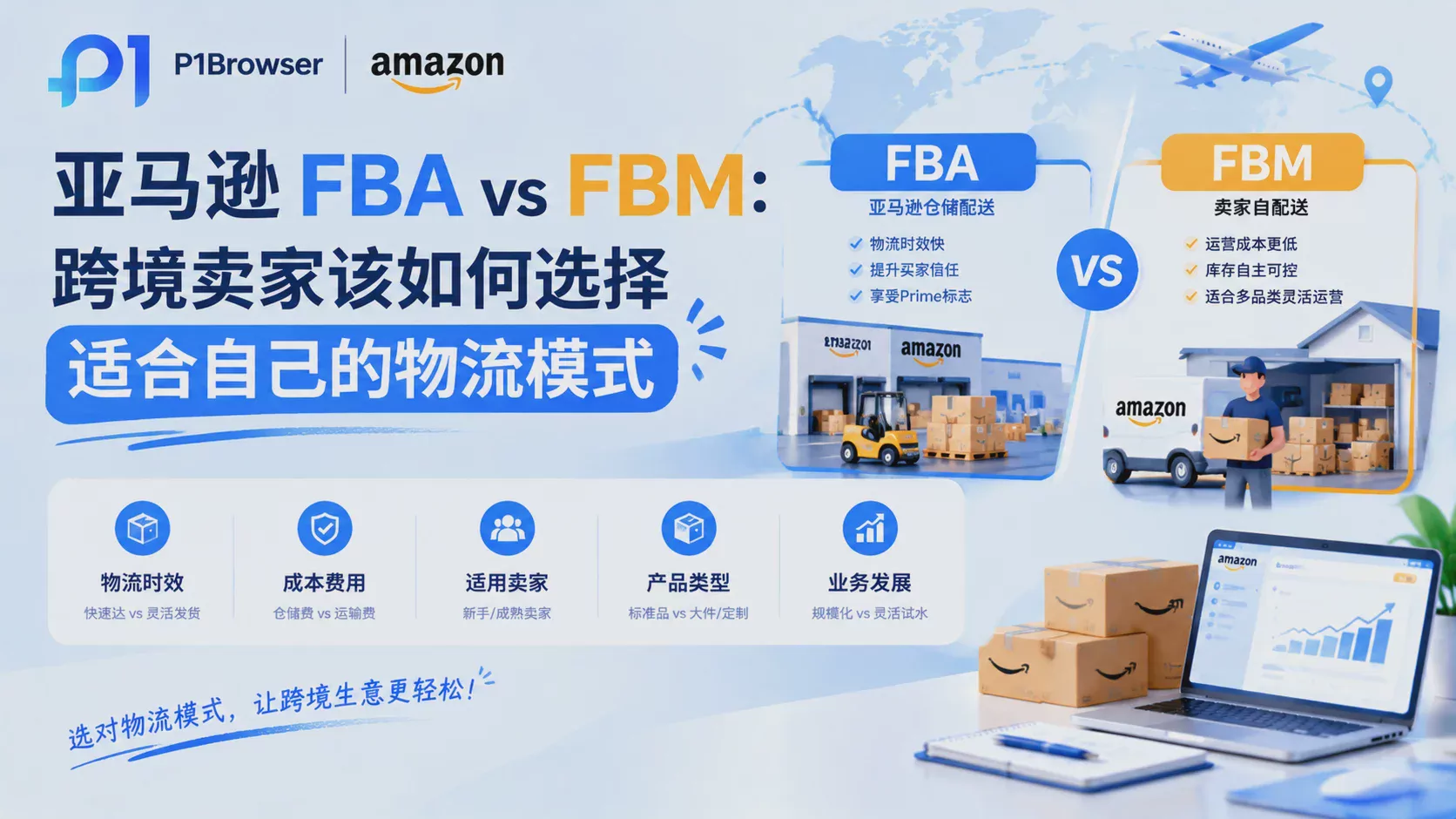
Choose the Wrong Logistics Model and Your Profits Get Eaten Alive
For many new sellers, the first real challenge after launching a store is not product selection but logistics. FBA carries high fees and ties up capital; FBM self-fulfillment is slow and makes it hard to maintain a good rating. More dangerously, you may not even realize you've made the wrong choice—your product is clearly competitive, yet poor logistics drags down conversion rates or inventory piles up until cash flow breaks.
This article directly answers one question:Should your product go with FBA or FBM?It won't list every detail of both models. It only provides verifiable criteria.
Quickly judge using three verifiable dimensions: average order value, turnover speed, and capital budget. The more criteria you hit, the more FBA suits you.
What Exactly Is the Difference Between FBA and FBM?
The core distinction can be summed up in one sentence:Who is responsible for storage and delivery.
FBA (Fulfillment by Amazon) means Amazon manages the entire process from receiving, storage, picking, and packing to delivery—you simply send your inventory to Amazon's warehouses. FBM (Fulfillment by Merchant) means you handle storage, packing, and shipping yourself, while Amazon only manages the front-end display and order matching.
This difference directly impacts three dimensions: buyer experience (delivery speed and the Prime badge), operating costs (storage fees vs. first-mile + self-fulfillment costs), and traffic weighting (FBA products typically earn higher search rankings and Buy Box probability).
Which sellers and products are a good fit for FBA
FBA is not a "universal cure-all." It's designed for products and sellers that meet the following criteria:
- Moderate-to-high average order value ($20 and above)— FBA fulfillment fees are a fixed percentage, so low-priced products will see margins eaten up by fees
- Fast inventory turnover with relatively accurate demand forecasting— FBA storage fees are charged by volume and duration, so slow-moving inventory becomes a hidden cost
- Small product size and light weight— FBA delivery fees for large items are extremely high. Calculate whether first-mile + FBA fees are still cost-effective.
- You have the budget to cover upfront costs.— FBA requires stocking inventory at Amazon warehouses first, tying up capital on the front end.
- You prioritize Buy Box and conversion efficiency.— FBA products come with the Prime badge, and search ranking and Add to Cart conversion rates are generally higher.
If your product meets 3 or more of the above criteria, FBA is the priority option.
Which sellers and products FBM is best suited for
FBM is suitable for the following scenarios:
- Light, small items and low-AOV products— FBA storage and delivery fees may exceed your profit margin. Self-fulfillment (especially via overseas warehouses or dedicated shipping lines) offers more cost control.
- The product testing phase— Before sales volume is confirmed, FBM lets you test market response in small batches and avoid the risk of large inventory commitments.
- Customized or non-standard products— FBA is not suitable for SKUs that require post-processing such as assembly or engraving
- New sellers with tight cash flow— FBM does not require shipping inventory to Amazon warehouses in advance, resulting in less financial pressure
- Testing multiple marketplaces on a small scale— FBM allows flexible switching between marketplaces without needing to stock inventory at each one
Hybrid model: Can FBA and FBM be used simultaneously?
Yes, and many established sellers work this way.
The core idea isto allocate channels by product, not by platform. FBA handles high-volume bestsellers and Prime-sensitive products, while FBM covers product testing, long-tail SKUs, and cost-sensitive categories. The specific steps are as follows:
- Map out your product matrix——List all SKUs and score them across three dimensions: turnover rate, average order value, and size/weight.
- Switch best-sellers and Prime-sensitive products to FBA.——These products are most sensitive to the Buy Box and conversion rate; FBA benefits outweigh the costs.
- Keep test products and long-tail items on FBM.——Avoid blind inventory stocking; validate sales with FBM before deciding whether to switch to FBA.
- Establish an FBA-to-FBM exit mechanism.——When storage fees exceed expectations or sales remain consistently low, switch back to FBM promptly to cut losses.
The hybrid model is essentially using FBM as a firewall and FBA as the engine. When managing multiple stores and product lines, it is recommended to also refer tomulti-account management solutions based on browser isolation technology, to reduce the risk of account association. Before preparing to open a store, you can also first read througha detailed breakdown of Amazon store setup costs, to get a clear picture of the overall cost structure.
Common Choice Questions
Frequently Asked Questions
Should new sellers start with FBA or FBM?
It depends on your budget and product. If you have limited funds and your product is in the testing phase, start with FBM to complete your first order process, then switch to FBA after validating sales. If you already have a clear bestseller and sufficient budget, starting directly with FBA is more efficient.
Will FBM affect account health?
It will not directly cause account issues, but FBM fulfillment times, return rates, and customer service response are all factored into account performance metrics. If self-fulfillment is frequently delayed or results in a high volume of returns, Amazon will restrict your selling privileges.
Can FBA and FBM be used simultaneously?
Yes. Amazon allows the same SKU to be fulfilled via both FBA and FBM (known as the "multi-channel fulfillment" model), but in practice, more sellers split by product: bestsellers use FBA, while the rest use FBM.
What is the "best time to switch to FBA"?
When an FBM product has stable sales for 30 consecutive days and projected inventory can support 2-3 weeks of fulfillment, that is the right time to switch to FBA. Switching too early may lead to excess inventory, while switching too late may cause you to miss peak-season traffic.
Will mixing FBA and FBM shipments result in penalties from Amazon?
No. Amazon explicitly allows sellers to mix FBA and FBM fulfillment under the same Listing. This is a standard operating method on the platform, as long as fulfillment times and return rates meet the required standards.