


A beginner seller in the apparel niche spent a week comparing the back-end dashboards of both platforms and ended up stuck in the same spot: one charges 5% commission, the other 15% – a 10-point gap – and then what? What truly blocked the decision were three more fundamental questions: Can I control my own first-order traffic? After deducting all fees from a single order, what's actually left? From my warehouse to the buyer's hands, who is responsible for which leg? Until those three questions are answered clearly, whether the commission gap is 10 points or 3 makes no difference as a decision-making basis. Below, I'll address only those three things.
The Traffic End: Where Does Your First Order Actually Come From?
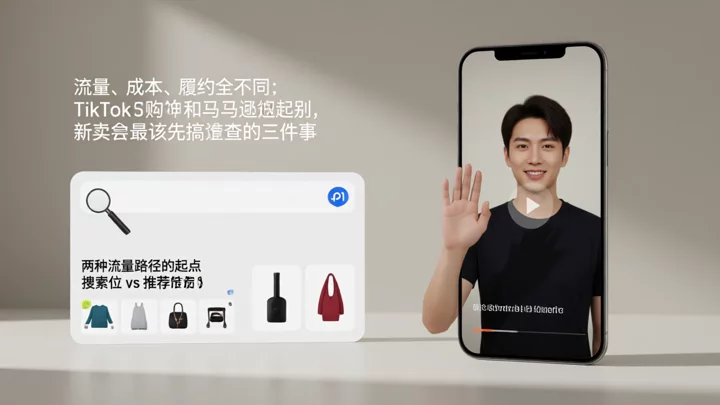
Amazon's order-generation logic is 'buyer searches → you occupy the slot → transaction.' New sellers have virtually no organic search weight in their first 90 days, so orders depend heavily on CPC ads – you bid on keywords to buy ad placements and pay per click. Budget is controllable, but the ceiling is clear: the more competitive the category, the higher the share of GMV going to ads, with 8%–15% being a common range. Turn off your ads and order volume drops immediately.
TikTok Shop takes a different path: the algorithm pushes content to people who might be interested, and users impulse-buy after stumbling onto a short video or live stream. In the first 90 days, the core variable isn't keyword ranking – it's the watch-through rate of individual videos and average dwell time in live rooms. The platform doesn't charge for 'search slots,' but if you don't have stable content production capacity – at least 1–2 original short videos or 1 live stream per day – so-called 'free traffic' is a false premise for you; the algorithm simply won't surface your content. With a team of 1–3 and no dedicated content-shooting colleague, the hidden time cost of this path far exceeds the surface commission rate.
The Cost End: What Does a Single Order Really Cost?
Using a $50 average order value and 500 orders per month as the baseline (the figures below are illustrative relative metrics and do not represent actual statistics):
| Cost items | Amazon (FBA model) | TikTok Shop |
|---|---|---|
| Platform commission | ≈ 15% ($7.5) | ≈ 5%–8% ($3–4) |
| Advertising / creator commission | PPC accounts for 8%–15% of GMV | Creator commission 20%–30% |
| First-mile + last-mile logistics | FBA fulfillment ≈ $4/order | Platform-partnered logistics ≈ $3/order |
| Return loss | ≈ $2/order | ≈ $1/order |
| Net gross margin per order (estimated) | ≈ $35–37 | ≈ $29–33 |
Key finding: The nominal commission gap is 10 points, but once you factor in creator revenue share and PPC ad spend, the actual gross margin gap narrows to $3–8/order. The conclusion that "TikTok has lower commissions" does not hold up across the full cost chain — the commission you save is most likely given back at the creator revenue share stage.

Fulfillment: How the package reaches the buyer
Under Amazon's FBA model, you ship inventory to Amazon's fulfillment centers, and the platform handles last-mile delivery, returns intake, and basic customer service. The core KPIs you monitor are inventory turnover days and your IPI score — once inventory sits for over 90 days, storage fees escalate in tiers. The inbound processing cycle typically runs 7–14 days, so you need to plan your stocking cadence well in advance. High certainty, but heavy capital lockup.
In its early stages, TikTok Shop relied primarily on platform-partnered logistics, with seller self-fulfillment typically requiring dispatch within 48 hours. Reverse logistics for returns were managed by sellers independently, with no platform safety net like FBA. Fast shipping and quick cash recovery, but all after-sales pressure is on you. Your logistics choice directly impacts cash flow speed—refer tothe selection logic from air freight to overseas warehousesfor further assessment.
Which path matches your resources
- Startup capital < 2 wan yuan, no content team, team of 1–2 people → start with Amazon.CPC ad budgets are manageable, FBA returns have a platform safety net, and order flow is predictable. Qualification and capital requirements can be found inthe complete beginner's checklist for individual cross-border e-commerce sellers.
- Has short-video production capacity or signed creator partnerships, startup capital 2–5 wan yuan → prioritize TikTok Shop.Creator commission shares are high but scale quickly, and return rates are typically lower than FBA return rates. Unified management of ads and business assets can be achieved through TikTok Business Center Setup Guide to define team permission structures.
- Funding > 5 ten-thousand, with sufficient budget for both platforms → Amazon as the core base, TikTok Shop for incremental growth.However, when operating on both platforms simultaneously, inventory writes, pricing routing, and account operations must be isolated; otherwise, cross-platform composite signals are more likely to trigger risk controls. For specific isolation methods, seeHands-on Amazon Multi-Account Operations and TikTok Shop Store Management. If multi-platform tool selection is involved, further referenceComparison of Commission, Logistics, and Traffic Acquisition Mechanisms Across Cross-Border E-Commerce Platforms.
Frequently Asked Questions
Can you run TikTok Shop without a follower base?
Yes, but the prerequisite is that you have content production capacity. Algorithmic recommendations do not look at follower count; they look at the completion rate and engagement rate of individual videos. If you lack production capacity, sign up influencers and use revenue sharing in exchange for exposure. Get your first 50 orders running smoothly before considering building your own content.
What is the minimum inventory level for Amazon FBA?
There is no hard minimum, but an IPI score below 400 will limit storage space. In practice, it is recommended to ship at least 30–50 units per SKU; below this volume, the proportion of storage fees will significantly erode profits.
Can both platforms be launched simultaneously?
Yes. However, when the same entity and the same device setup operate multiple platforms simultaneously, cross-platform composite signals are more likely to trigger review than in-platform configuration settings.Amazon's Official Multi-Account Health NoticeThis indicates that issues with one account may affect associated accounts. Account notifications and official policies shall prevail.
If I start on one platform first, can I migrate to another after 3 months?
Yes—product selection and supply chain can be reused. However, the traffic models are entirely different: keyword weight and content weight cannot be directly transferred, and a cold start is required. We recommend focusing on a single platform for the first 3 months to establish the order-fulfillment pipeline before opening a second one.

