



When a Shopee Seller Center popup flags an account restriction or suspension, most sellers' first instinct is to open the appeal form. But filing at the wrong tier wastes the window. For the first 30 minutes, do only one thing: use three quick checks to pinpoint which tier triggered the ban—compliance tier (product links flagged for IP complaints or missing category qualifications), performance tier (ODR spike or consecutive late-shipment rate breaches), or association tier (multiple stores under the same entity sharing network exits or overlapping payment entities). The diagnosis directly determines your action path for the next 48 hours.
The First 30 Minutes After Receiving a Suspension Notice: Diagnose First, Then Act
Execute the three checks in order. First, go to Shopee Seller Center → Product Management → Delisted / Restricted Products and check whether any links have been flagged by the platform for IP complaints or false advertising. If yes, it falls under the compliance tier, and the appeal direction is to submit an authorization letter or category qualification documents. Second, open Account → Health Dashboard and check whether ODR has jumped from below 1% to above 3% over the last 7 days and whether late shipment has exceeded 10% for 3 consecutive days. If yes, it falls under the performance tier, and the appeal direction is to submit shipping proof and a remediation timeline. Third, check whether a second Shopee store or other platform accounts are registered under your current office IP, and whether the receiving account entity overlaps with other stores. If so, this triggers an association-tier review, and the appeal direction is to prove that each store operates independently with no common controller.
Three-Tier Trigger Signals and Evidence Required for Appeal
- Compliance Tier: IP complaint ticket number, original design source files of the product, brand authorization chain, or self-owned trademark certificate. Missing any one of these will typically result in the appeal being rejected within 24 hours with a request for supplementary documents.
- Performance Tier: Screenshots of shipping records for the past 30 days, carrier delivery confirmation, and communication records with the buyer (to prove the negative review was not malicious). ODR recovery requires staying below 1% for 14 consecutive days, with no further delays during this period.
- Affiliation Layer: Proof of independent network exits for each store (ISP bills or proxy service provider reports), device serial number list, and a cross-reference table of payment account entities and business licenses. If you are operating multiple Amazon accounts simultaneously, refer toAmazon Multi-Account Affiliation Risk Control Self-Check Checklistto verify all five layers of signals item by item.
48-Hour Recovery Action Path
- Day 0 (Day of Notification): Take screenshots to preserve the full ban notification, the current health score on the dashboard, and the list of restricted products. Navigate to Shopee Seller Center → Account → Health → Submit Appeal, select the corresponding tier, attach no more than 5 files, each not exceeding 10 MB. Simultaneously, email Shopee Seller Support with the subject line "Account Appeal + Store ID + Tier Keyword" and include the ticket number in the body.
- Day 1: Supplement any evidence missed on Day 0, such as a delay explanation issued by the carrier or a brand authorization letter. Check your email for any follow-up from the platform; respond within 4 hours—failing to do so is considered a withdrawal of this round of appeal.
- Day 2: The 72-hour restriction is typically lifted within this window. If the status remains "Under Review," do not resubmit (it will reset the timer); instead, add supplementary notes to the original ticket. Permanent bans (where the account entity is determined to be under the same controller with no legitimate business reason) do not follow the above timeline and require legal proceedings at the corporate level.
Store Management Tools: Containing Account-Linkage Risk at the Tool Layer

Taking a three-account setup across Shopee + Amazon + TikTok Shop as an example, the three sync lines—inventory write, pricing routing, and operation timing—must each have a single clear owner. Inventory write: stock deduction for the same SKU across all three platforms is executed by one central ERP; each platform is read-only and does not write back, preventing the oversell window caused by Shopee having already deducted stock while Amazon FBA in-transit inventory has not yet been released. Pricing routing: each platform's profit-margin target is set independently; no single pricing sheet is shared. Operation timing: login windows for different accounts under the same IP are staggered by at least 30 minutes. This ownership logic is covered inCross-Platform Store Management Tool Efficiency Comparisonwith configuration tiers by team size; for diagnosing multi-account synchronized write breakpoints, seeCross-Border E-Commerce Multi-Account Operations Oversell Prevention Guide.
Cross-Platform Risk-Control Hard Boundaries: Three Non-Negotiable Isolation Lines
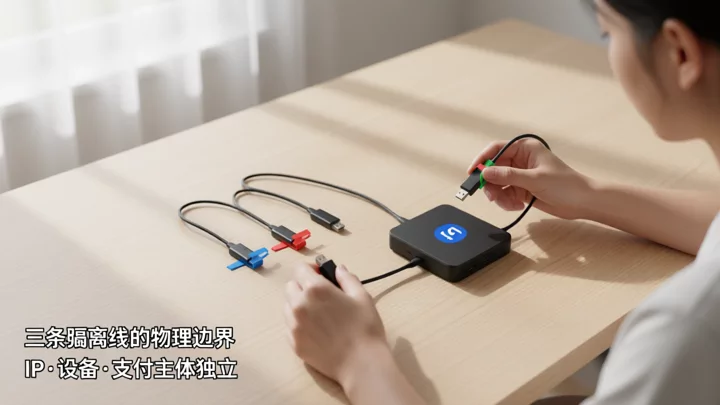
Network exit: each platform account uses a dedicated IP range; under the same proxy provider, different exit ports are used, with no shared NAT pool. Device fingerprint: isolated browser instances or virtual-machine separation; no sharing of localStorage or Cookie domains on the same physical machine. Payment entity: each store is linked to a receiving account under a distinct legal entity; no sharing with any legal person or sole proprietor other than the registered business-license holder. These three are the minimum standard—miss any one, and during a platform linkage audit, multiple accounts will be grouped under the same controller. Amazon's official guidance on multiple seller accounts also emphasizes thatA policy issue on one account may affect linked accounts, with disposition standards subject to each platform's account notifications. For additional tool selection and isolation measures, refer toHow Many Tool Sets Are Needed for Multi-Account Management.
Frequently Asked Questions
What Is the Difference in Appeal Timelines Between a 72-Hour Restriction and a Permanent Ban?
A 72-hour restriction goes through the appeal channel within Seller Center, with results typically issued within 48 hours; do not resubmit during this period. A permanent ban requires contacting Shopee Legal or local consumer protection channels, with a cycle starting from 30 days and requiring cooperation from the legal entity.
Are Performance Scores Reset After an Account Is Unfrozen?
ODR and late-shipment metrics are not reset; historical data is retained for 90 days. However, zero orders during the restriction period are excluded from the ODR denominator, so scores will initially run high due to the smaller denominator. Scores will automatically stabilize after 14 consecutive days of active orders.
Does Reusing Creative Assets Between Shopee and TikTok Shop Trigger Cross-Platform Risk Control?
No asset-comparison system exists between the two platforms, but operating two accounts simultaneously from the same IP for content distribution generates overlapping operation-timing signals, which surface as supporting evidence during linked-account reviews. Staggering operation windows or using a dedicated network exit can eliminate this signal.

