



On Wednesday afternoon, your eBay Seller Hub pops up a 'recent abnormal login activity' alert; on Friday morning, AliExpress Seller Center follows with a similar notice. You open your multi-store management tool's sync logs—all green, no errors, no failure records. But isolation has already silently broken at the seams. The tool never 'told' you where things went wrong; it simply failed to surface the issue as an error.
This article covers only the cross-linking risks among the three platforms: eBay, Walmart, and AliExpress. If you currently manage accounts on all three and have not yet received a single risk-control email, the following three signals can help you determine within 30 minutes whether your current tool layer has hidden gaps. No need to wait for a store-suspension notice before looking back.
Two Risk-Control Emails in 48 Hours: No Tool Errors, but Isolation Has Already Failed
Most sellers' understanding of 'account linking' stops at the IP or credit card level. But what eBay's and Walmart's risk-control systems actually cross-identify is behavioral patterns: when the same machine completes a 'login → price change → inventory update' sequence within a close time window, and the browser fingerprint is not differentiated at the platform level, it gets flagged as the same entity. If an AliExpress sub-account inherits the main account's outbound IP range, it effectively welds the data behavior of all three platforms to a single signal source.
The key point: this kind of failure produces no tool error. Your inventory sync script runs to completion, order allocation rules match, and the logs show 'success.' But at the login credential layer, the fingerprint layer, and the timeline layer, the tool may simply not cover these areas at all, or its coverage amounts to 'nominal isolation, de facto sharing.' The three signals below target exactly these three layers.
Signal One: Login Credentials and Browser Fingerprints Are Not Truly Isolated Per Platform
Open your store management tool or browser configuration and check each of the following criteria one by one. Each item lists a normal value and an abnormal value—you can complete the check in 10 minutes:
- Session cookie ownership: Normal — eBay, Walmart, and AliExpress each use a separate browser profile or separate cookie container; Abnormal — the cookie storage of the same profile simultaneously contains
.ebay.comand.walmart.comsession tokens, with no distinction made via HTTP-only or Secure flags. - Egress IP range: Normal — the egress IP captured within 5 minutes after logging into each platform falls into a different range; Abnormal — after logging in with an AliExpress sub-account, packet capture shows the egress IP falls within a proxy range previously used by the main account, while eBay and Walmart share the same proxy egress.
- Browser fingerprint consistency: Normal — after using the fingerprint detection tool to visit each of the three platforms, at least two of the three items — Canvas, WebGL, and font list — differ; Abnormal — all three are identical, indicating the tool does not apply platform-level fingerprint perturbation.
- Credential storage isolation: Normal — API tokens for the eBay seller account and the Walmart seller account are stored in separate key vaults or encrypted fields; Abnormal — the tool writes multi-platform tokens in plaintext to the same local config file, and the file permissions are 644.
If more than two of the four fall on the "abnormal" side, it means your tool has not achieved true isolation at the login environment layer. In this case, we recommend cross-referencing thepractical audit checklist for seller center risk controls and store management tools in multi-account operations, and fill gaps layer by layer across four dimensions: login credentials, network exit, browser fingerprint, and data behavior. If you are also operating on TikTok Shop or Shopify, you can refer tocross-platform minimum isolation configuration and four-step troubleshooting path.
Signal Two: Operation Timing Assembled into a Single Behavior Pattern Across Platforms
Risk control systems look not only at "what you did" but also at "when, at what pace, and from what network environment you performed the same set of actions." When you use the same machine and the same toolset to complete an eBay price change within a 10-minute window and then switch to a Walmart inventory update, and the User-Agent, mouse trajectory rhythm, and network latency profiles of the two operations are highly overlapping, eBay's and Walmart's risk control models can attribute both records to the same operator.
The timing conflict matrix below highlights high-risk intersection cells across 4 operation nodes on 3 platforms. If your tool's scheduler does not insert an independent time window (recommended: ≥ 15-minute random interval) and a separate network exit for each platform, the cells marked with "●" in the matrix are accumulating risk every day.
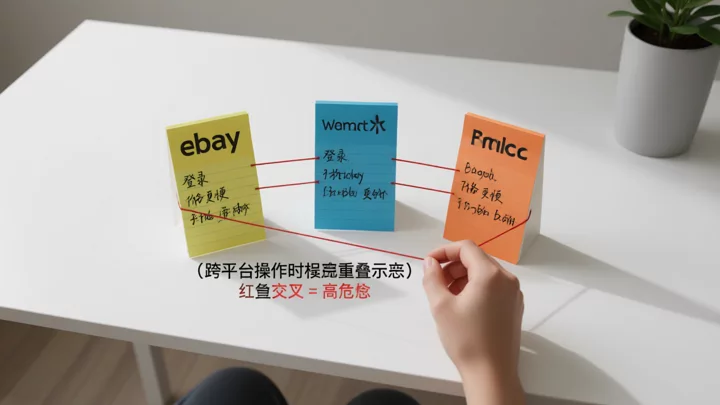
In the matrix, the consecutive "Price Change → Inventory Update" sequence is the highest-risk combination: if eBay's listing price field update and Walmart's FDS inventory sync are completed in the same batch of API calls, the backend timestamps on both platforms will point to the same second. If an AliExpress sub-account is also modifying SKU inventory at that moment, the three timelines overlap, further increasing the degree of behavioral fingerprint convergence.
Signal Three: Tools Silently Fail at Platform Seams
A fully green tool log does not mean every field on every platform has been correctly mapped and synchronized. Each platform has its own unique 'seam'—the layer tools are most likely to miss. When missed, no error is thrown, but within 7 days it will most likely trigger an administrative action on the platform side.
| Platform | Most Easily Missed Seam | Most Likely Platform Action Within 7 Days After Failure |
|---|---|---|
| eBay | Listing field mapping: Title character encoding and attribute taxonomy IDs are silently truncated during cross-platform synchronization | Search ranking demotion → Sharp drop in impressions → Triggers 'low-performance listing' review |
| Walmart | FDS delivery time commitment not synchronously refreshed after inventory changes | Fulfillment timeout rate exceeds threshold → Delivery rating downgraded → Traffic deprioritized |
| AliExpress | Sub-account permission inheritance: After the primary account changes its risk-control policy, sub-accounts fail to inherit the new restrictions in sync | Sub-account actions flagged as "privilege escalation" → store rate-limiting or freezing |
How to check: manually edit an eBay listing title in the tool, then observe whether the corresponding SKU title on AliExpress is synchronously overwritten; after modifying Walmart inventory, check whether the FDS promised-delivery field updates in tandem. If any field fails to update and no log entry exists, that seam has silently broken. For troubleshooting approaches, refer tothe four-layer troubleshooting method for multi-store inventory sync failures,focusing on the fourth layer, "Tool Environment".

Assess whether your current tool tier is sufficient for your actual scale
- Define the scale tier: Count your total SKUs, daily average orders, and number of active platforms (eBay + Walmart + AliExpress = 3). Total SKUs < 200 and daily orders < 50 fall into the "Spreadsheet Tier"; SKUs 200–2000 with 50–500 daily orders fall into the "Multi-Browser + Proxy Tier"; SKUs > 2000 or daily orders > 500 require the "Unified Workbench Tier".
- Cross-check signals to identify gaps: Signal One missing → you need platform-level browser environment isolation; Signal Two missing → you need a task scheduler with randomized time windows; Signal Three missing → you need a field-level mapping audit and FDS delivery-time linkage module. Mark the missing layers on your tool capability matrix.
- Actionable upgrade or downgrade steps you can execute today: Spreadsheet tier → Replace shared configurations with independent browser profiles + a different proxy segment per platform, at zero cost; Multi-browser tier → Insert a random 15–30 minute offset for each platform in the scheduler and enable outbound IP rotation; Unified workspace tier → Confirm whether the tool covers the three seam fields listed in the table above; if not, fall back to the multi-browser tier and manage the seam layer manually to avoid a tool that is 'nominally synced but actually dropping fields.' For a specific tool tier comparison, refer toa tool selection comparison based on inventory scale and daily order volume .
When the chosen tier doesn't match your capability gap, over-purchasing won't make your isolation safer—extra features nobody configures are as good as nonexistent, and under-capability means you're running exposed every day. Picking the right tier matters more than stacking features.
Frequently Asked Questions
All three platforms share one proxy IP pool—do I have to replace all of them immediately?
No need for a panic-driven full swap. First, capture packets to confirm whether the outbound IPs after logging into the three platforms actually fall within the same /24 segment. If they do, at minimum move the AliExpress sub-account to a separate segment (even if it's just a different outbound within the same proxy pool). eBay and Walmart can share a segment, but you need to space them at least 20 minutes apart at the scheduling layer. A shared proxy pool doesn't inherently cause linkage, but the risk rises significantly when 'same IP segment + same time window + same fingerprint' all overlap. For specifics, follow each platform's account notifications andeBay Seller Centerofficial policies as the authoritative reference.
An AliExpress sub-account and the main account use the same business license—does that count as a linkage risk?
AliExpress officially allows sub-accounts under the same business entity, but the sub-account must maintain distinguishable, independent signals at the data-behavior level (operating IP, browser environment, price-change cadence) relative to the main account and any cross-platform accounts. The shared business license itself is not a reason for account closure, but if the sub-account fully inherits the main account's outbound IP and operation timing, it's equivalent to exposing a 'one person, multiple accounts' signal to the risk-control model.
I'm also running Shopee or Lazada at the same time—does the same troubleshooting logic apply?
The core logic is consistent: login environment isolation, operation sequence decoupling, and seam field mapping. However, the seam points differ between Shopee and Lazada—Shopee emphasizes mega-sale order claim rules, while Lazada focuses on three metric lines: fulfillment, cancellation, and disputes. When stacking multiple platforms, it is recommended to proceed according tothe phased tasks from getting a single store running to replicating across multiple stores,progressing layer by layer rather than rolling out risk control configurations for all platforms at once.
Your tool logs are all green, but eBay has flagged an abnormal login alert. What should you check first?
Start with the browser fingerprint layer: open the browser profile your tool uses, visit the eBay Seller Hub with a fingerprint detection tool, and compare whether the Canvas and WebGL outputs are consistent with the Walmart side. If they match, it means the tool has not implemented platform-level fingerprint perturbation—this is the most easily overlooked layer and can be fixed the same day. After the fix, monitor for 72 hours; if the alert does not reappear, you have most likely identified the root cause.