


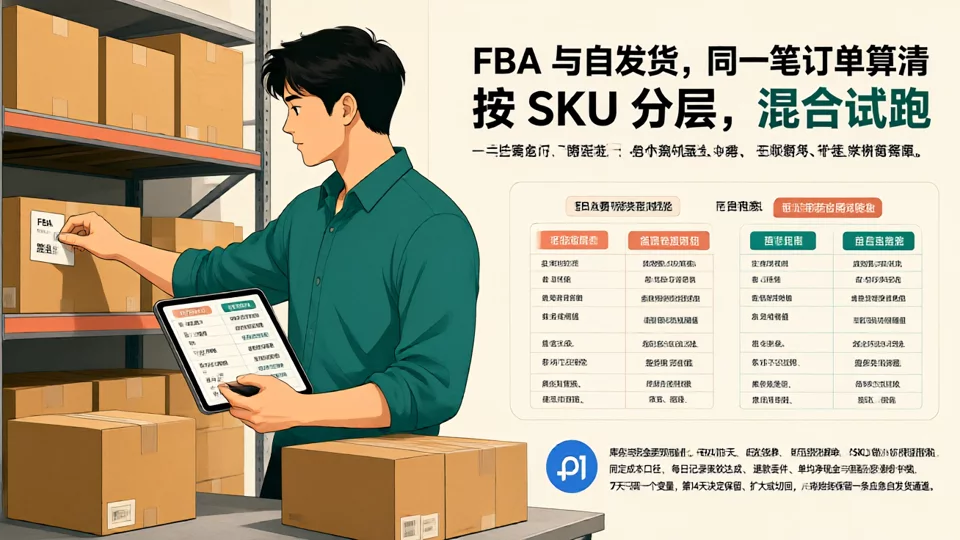
An order that shows a gross profit of 20 yuan in the backend may actually be negative after accounting for everything: first-mile, storage, platform delivery fees, return handling, self-shipping costs, packing labor hours, and lost package compensation. No single item looks large in isolation, but stacked together they can wipe out all gross profit. Therefore, choosing between FBA and self-shipping cannot be based on "shipping cost per kg" alone. Both lines must be measured with the same ruler:Order net cash, plus yourcontrolover inventory, lead time commitments, and customer service responsibilities.
Order Segmentation Map: Why FBA and Self-Shipping Can Coexist
Replacing "which one to choose" with "which SKUs go through which channel" makes the problem immediately actionable. Walk through products across five dimensions: whether the average order value can cover delivery and storage costs, whether volume/weight triggers oversize surcharges, buyer sensitivity to lead time, return rate, and inventory turnover days.
- Primary FBA: small volume, low weight, time-sensitive, manageable return rate, stable turnover, and shipping costs that remain acceptable relative to the average order value.
- Primary self-shipping: large items, ultra-low average order value, slow turnover, custom or pre-order items, and seasonal end-of-season inventory where holding costs significantly exceed direct shipping rates.
- Hybrid pilot: For new products and SKUs with uncertain sales volume, start with self-shipping to test demand, then switch to FBA once orders stabilize.
Switching conditions must be predefined, not decided on the fly after problems arise: if FBA storage and removal fees for a specific SKU exceed its per-order contribution for two consecutive months, reduce the ratio or switch to self-shipping; if self-shipping shows rising delays, failed deliveries, or refund rates, switch time-sensitive orders back to FBA.

Cost comparison: Put the fees from both sides back into the net cash of the same order
FBA costs include at least first-mile and inbound warehouse fees, platform delivery fees, storage fees, return processing fees, and removal fees; self-shipping includes international shipping, packaging materials and labor, loss compensation, and refund reshipping. Both sides must include commissions and advertising to be considered “net.” The figure below only illustrates the relative magnitude and ranking of cost items for the same SKU; it is not actual pricing. Please replace it with the figures from your current invoices.
A more reliable approach than "shipping unit price" is to create a net cash flow statement per order for each SKU: revenue minus all the costs listed above, then examine how many days the capital is tied up. The same gross profit figure has a completely different cash value if it is locked in an FBA warehouse for 90 days compared to a direct shipment that recoups cash in 7 days. The allocation method can referenceFrom Shipping to Tariffs: A Cross-Border E-Commerce Logistics Cost Calculation Tutorial, where the formulas include both tariffs and return reserves.
Lead Time and Experience: How Promise Lead Times, Tracking Rates, and Refund Rates Impact Performance
This layer does not compare "who is faster," but rather compares who bears the risk.
| Dimension | FBA | Self-Ship |
|---|---|---|
| Promised Lead Time | Set by the platform's fulfillment system, usually shorter | Set by the seller; the shorter the timeframe, the greater the assessment pressure |
| Tracking and Delivery | The platform covers scanning and delivery confirmation records | A valid tracking number must be uploaded, and the tracking status must remain updated |
| Post-sale liability | The platform handles returns and part of the customer service | Sellers are responsible for refunds, reshipments, and lost package claims |
| Performance risk | Risk is transferred to inventory and account compliance | Timeouts and failed deliveries directly impact account metrics |
The applicable boundary is: time-sensitive and high-AOV orders go through FBA; large items, non-time-sensitive, and long-tail orders use self-fulfillment, with promised delivery times widened to a level you can reliably achieve. Specific assessment criteria are subject to account notifications and official policies from each platform, as judgments vary across different sites.
Inventory and cash tie-up: Quantify both stockpiling and order surges
FBA cash tie-up must be calculated in three parts: on-hand inventory, in-transit inventory, and post-stagnation storage fees plus removal fees. Estimate safety stock using “projected days of sales × average daily sales volume,” then multiply by the unit cost to determine the locked-in cash. Before stocking up for peak seasons, ask this: if sales are only half of the forecast, will this inventory be discounted to clear it, or will removal fees be paid?
The risk with self-fulfillment lies on the other side: logistics carrier capacity, peak season space availability, and lost package compensation caps. Inability to ship during an order surge damages net cash just as severely as unsold inventory; when the compensation cap is lower than the goods' value, a single lost package can erase the profit from more than a dozen orders. Seasonal items, large goods, and low-turnover products are not suitable for blind FBA stocking. Conversely, for standard products with stable sales, relying solely on self-fulfillment long-term makes it difficult to control delivery times and refund rates.
Run a small-scale mixed pilot for 14 days to define your own switching thresholds
- Select 20–50 orders or 1–2 SKUs, running FBA and self-fulfillment in parallel without aiming for a full switch.
- Standardize cost metrics: use a single spreadsheet to record first-mile, delivery fees, storage, shipping, compensation, and packing labor hours.
- Track four numbers daily: promised delivery SLA compliance, refunds or lost items, net cash per order, and customer service handling minutes.
- Review on Day 7, adjusting only one variable (delivery promise, packaging, or logistics provider); do not change three at once.
- Decide on Day 14: keep, expand, or revert; document the trigger conditions in the SKU notes.
- Regardless, maintain a backup self-fulfillment channel to cover FBA inbound delays or stockouts.
The most common reason for pilot failure is inconsistent metric definitions; for reference on defining metrics and recording sheets, see theCross-border E-commerce Data Dashboard Setup Tutorial, align logistics costs, refunds, and labor hours to a single order-level detail sheet, then determine whether to adjust the mix ratio.

FAQ
Will FBA storage fees eat into the profit of low-ticket SKUs?
Yes, but it depends on turnover. Add up monthly storage fees, long-term storage fees, and potential removal fees, then divide by the order volume for the same period to get the average fulfillment cost per order. If this is already close to the average contribution per order for that SKU, it is better to ship these SKUs yourself or discontinue them.
If self-shipment performance metrics are not met, should I fix logistics or adjust committed delivery times first?
First, confirm which stage caused the delay: if trunk line is slow after pickup, switch logistics providers; if packing and shipping are slow, adjust internal cut-off times; if both stages are normal but the committed time is too aggressive, relax the delivery promise. If you change all three at once, you will not know which one made the difference.
How do I decide whether a SKU should switch between FBA and self-shipment when I run both?
First, segment SKUs by ticket size, dimensional weight, time sensitivity, return rate, and inventory turnover days; then set hard switching rules: if FBA storage and removal fees exceed the SKU's average contribution per order, lower the FBA ratio or switch to self-shipment; if timeout rates, non-delivery rates, or refund rates rise on self-shipment, move time-sensitive orders back to FBA.
If a new seller does not have stable order volume, should they start with FBA or self-shipment?
Start with self-shipment or a small amount of FBA to test real demand, and calculate return rates, delivery performance, and average net cash per order before deciding inventory levels. Putting large inventory into FBA without sales data is essentially using inventory to gamble on product selection.