



With a monthly GMV of 8 wan, Amazon's all-in costs swallow 38% of gross margin, TikTok Shop still delivers free traffic but carries a 22% return rate, and the 2 wan spent on building an independent site has yet to crack CAC—where to deploy the next 3 wan in budget is a real sticking point for most small-to-mid sellers. The core of cross-border e-commerce platform comparison is not listing who is good and who is bad, but compressing the three threads of commission structure, logistics cost, and traffic acquisition mechanism into a single tiered matrix: the same SKU has a completely different optimal combination at the 5 wan and 50 wan monthly GMV milestones.
The Cost Black Holes of Six Channels—See It All in One Chart
Stack commission, logistics allocation, advertising, and platform service fees together, and the share of all-in channel cost to GMV varies widely. Amazon vs. an independent site is essentially asking: are you willing to trade certainty for margin (platform commission + ranking compression), or trade uncertainty for long-term brand equity (self-built traffic + payment gateway)?
Beyond commission, payment-channel fees plus settlement cycles will consume an additional 1.5–3% of cash flow. If mid-to-small sellers get caught up on PayPal and Payoneer settlement schedules, their restocking window gets halved,Besides PayPal and Payoneer, what other cross-border e-commerce payment methods are suitable for mid-to-small sellersis tiered by settlement cycle, so you can cross-reference your monthly volume to pick the right one.
Logistics cost isn't a question of air freight versus overseas warehouse—it's three threshold lines.
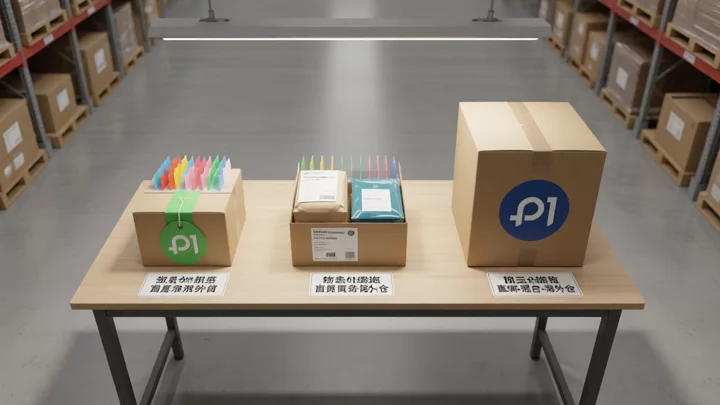
Three hard thresholds:AOV below 100 yuan goes via direct shipping; 100–300 yuan uses a hybrid model (core SKUs stocked in-warehouse, long-tail shipped direct); above 300 yuan or a return rate exceeding 15% mandates an overseas warehouse. Under Temu's and TikTok's full-consignment model, the platform bears logistics costs, but pricing power is ceded to the platform—this isn't saving money, it's just a different way of losing.
How AOV feeds into the overseas-warehouse decision, and how much weight delivery windows and return rates each carry—From Air Freight to Overseas Warehouse: Choosing a Cross-Border E-Commerce Logistics Model—Start with AOV, Delivery Windows, and Return Ratesare category-based tiered criteria you can check row by row against your own SKU sheet.
Three traffic-acquisition mechanisms and the cost–certainty asymmetry
- Platform algorithmic traffic(Amazon A9 / Shopee search ranking): Highest certainty—new products can land in organic placement within 30 days; but ads typically account for 10–20% of GMV, and once competitors lock in their slots, CPC doubles. Best for teams with monthly revenue of 5 wan+ and a stable SKU base.
- Content / short-video traffic(TikTok organic + paid): Cold start takes 60–90 days before stable orders. High ceiling but high volatility; return rates are generally 8–12 percentage points higher than shelf e-commerce. Best suited for categories with an average order value under 150 yuan and strong visual impact.
- Owned Channels(Standalone site SEO + EDM + social media): In the first 6 months, CAC sits at 80–200 yuan per order. From month 7 onward, it drops to 30–50 as content assets accumulate. However, sustained investment in content production is required. Not recommended as a primary channel during the 0–5 wan yuan monthly revenue stage.
The underlying logic of channel selection is not about which channel has the biggest traffic, but about which path matches your capital, time, and compliance tolerance.What Cross-Border E-Commerce Platforms Are There? Channel Selection Logic from Amazon to TikTok ShopThe mainstream platforms are grouped into four categories by operating model, which can help you lock in a starting channel.
Scale Tiers: What Each of the Three Seller Tiers Runs and What They Don't

| Monthly Revenue | Primary Channel | Secondary Track | Logistics Strategy | The Biggest Cost Trap | What to Add for the Next 10 Wan |
|---|---|---|---|---|---|
| 0–5 ten-thousands | Single Platform (Shopee/TikTok) | No Stacking | All Direct Shipping | Stocking Squeezes Cash Flow | Prove a Single-SKU Return Rate <12% |
| 5 to 50 (in ten-thousands) | Core Platform + One Content Line | Standalone Site for Brand Display Only | Top 5 SKUs into overseas warehouses, long-tail items via direct shipping | Overselling due to dual-platform inventory sync | Reduce independent site CAC to 50 yuan before scaling volume |
| 50 ten-thousands+ | Platform + independent site dual engine | Use the second platform for incremental growth | Overseas warehouses as primary + cross-border direct shipping to cover long-tail | Multi-account risk control linkage | Pull independent site's GMV contribution to 30% |
Once channels are locked in, compliance actions from entity registration to first-order warehouse exit follow a fixed sequence,From Entity Registration to First Order Shipment: A Five-Step Practical Path for Cross-Border E-Commerce Store SetupEach step's same-day verifiable completion markers broken down following a 72-hour cold-start rhythm.
Picking the right platform is only the first step — failing to keep up with the right tools is where real money gets lost.
Once orders start flowing across multiple platforms simultaneously, inventory synchronization, pricing ownership, and session maintenance become the biggest hidden costs. The same SKU can be decremented by different systems on two platforms at the same time, and overselling can happen within 40 minutes. Even with the right platform selection, if management doesn't keep pace, total operating costs will climb another 8–12%.Sellers running Amazon and Shopify at the same time: how should you actually pair up your shop management tools?breaking down the three layers of ownership — inventory, pricing, and order routing — into a same-day verifiable checklist; if you are running more than 5 platforms simultaneously,Cross-border e-commerce seller accounts in chaos? From eBay to Temu, manage 10 platforms with one set of shop management tools.it includes tool-switching thresholds tiered by number of stores × SKU complexity.
When running multiple accounts, Amazon's official documentation provides clear guidance on account association and account status:Amazon Seller Forum: Multi-Selling Account Health TipsIt points out that a policy issue on one account can affect linked accounts. When operating across platforms, the isolation granularity of network exits, login credentials, and payment entities directly impacts account security. Follow your account backend notifications and official policies as the authoritative reference.
Frequently Asked Questions
Monthly revenue at 12 wan — should you prioritize Amazon or the independent site?
Still in the 5–50 wan tier at 12 wan, put your main effort on Amazon for certainty. Use the independent site only for brand showcase + email list building, and do not invest in CAC. Wait until your independent site's CAC stably drops below 50 yuan before scaling up; otherwise, customer acquisition costs will eat up 1/3 of your platform profit.
Does TikTok Shop's zero commission mean it's more profitable than Amazon?
No. Zero commission, but advertising fees account for 12–18% of GMV, and return rates run 8–12 percentage points higher than shelf-based e-commerce. The combined cost of 22–28% is still below Amazon's 35–40%, but gross margins are partially eroded by returns and reshipment logistics. When the average order value is <80 yuan, TikTok is more cost-effective; at >200 yuan, Amazon FBA's return-cost advantage reverses the lead.
For a product with an 80 yuan average order value, when does using an overseas warehouse become cost-effective?
Two conditions must be met simultaneously before stocking into an overseas warehouse: monthly shipments for that SKU are stably >500 units, and the return rate is >15%. At 80 yuan average order value—below the 100 yuan threshold—the primary channel is direct shipping. Only when that SKU becomes a Top 5 product and returns drive secondary logistics costs to >12 yuan/order does overseas warehousing make sense, cutting per-order logistics from 18 yuan to 9 yuan.
Between fully managed and self-operated models, how large a return-rate gap flips the profit?
Under Temu/TikTok fully managed operations, logistics costs are absorbed by the platform, but once pricing power is ceded, gross margins typically compress to 15–22%. Self-operated gross margins are 30–40%, but every 5-percentage-point rise in return rate cuts net margins by 3–4 points. When self-operated return rates reach >28%, fully managed—even with ceded pricing power—delivers a higher net margin. That is the tipping point.
How long before a standalone site's SEO can replace 30% of Amazon's advertising spend?
Getting core keywords into the top 20 typically requires 6–9 months of sustained content investment. The first 3 months bring almost no organic traffic; long-tail keywords begin ranking in months 4–6; from month 7, CAC drops to 30–50 yuan. If monthly revenue is under 10 wan yuan, absolute advertising spend is under 2000 yuan/month, and the savings fall short of covering SEO content production capacity—better to focus on the platform first.

