


First, clarify who collects the money: platform collection, direct acquiring, or bank wire transfer
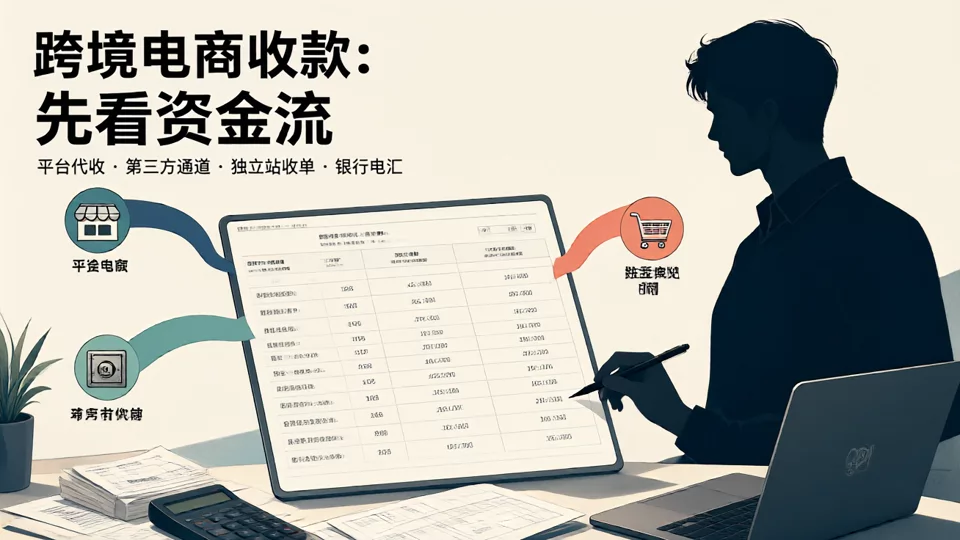
Cross-border e-commerce payment methods can be divided into four categories based on fund flow: platform-collected disbursement, collection accounts provided by third-party payment service providers, independent store direct acquiring, and bank wire transfers. Their differences do not lie in the level of fees, but inwho collects the funds, at which stage currency conversion occurs, and whether the withdrawal entity matches the store entity.
All three platform dashboards show funds as disbursed, yet the amount received in domestic bank accounts does not match the dashboard figures, and a chargeback is pending on the independent store side. At this point, do not rush to compare which fee rate is lower; instead, trace the fund flow backward: what fees did the platform deduct, did currency conversion happen at platform settlement or at withdrawal, and is the entity of the withdrawal account the same as the store's registered entity. These three questions correspond to different paths, and conflating them will lead to incorrect conclusions.
Platform-collected disbursement is the most common: buyers pay the platform, which deducts commissions, logistics fees, and advertising fees according to its settlement cycle before disbursing funds to your bound collection account. Sellers can only decide which account to bind; the currency conversion stage and settlement cycle are determined by platform rules. Independent stores are the opposite: the acquiring institution collects the money first, and you decide when to settle and which account to receive it in, while chargeback and refund risks remain on your side. Bank wire transfers are more common in B2B, sample orders, and large offline orders, where buyers remit via overseas banks, requiring you to provide account information, contracts, and invoices. It is slow, but involves larger single-transaction amounts.
First, confirm what type of store you operate, as this can save many invalid comparisons—the store type itself determines the payment path, which you can reference.Which Cross-Border E-Commerce Platforms Are There? A Comparison of Mainstream Types, Entry Thresholds, and Product Selection FitWhat payment documents need to be prepared before opening a store?From Registration to the First Order: The Complete Steps and Common Bottlenecks in the Cross-Border E-Commerce Store Setup ProcessThe corresponding checklist is available there.
Comparison of Four Common Paths: Platform Disbursement, Payment Service Providers, Independent Site Payment Gateway, and Bank Remittance
The table below lists the order in which money flows from the buyer to the seller; it does not rank the channels. Fees and settlement times vary by platform, site, legal entity, and order structure, so they must be verified item by item against the current agreement.
| Path | How the Funds Move | Who It Suits | Key Limitations |
|---|---|---|---|
| Platform Collection and Disbursement | Buyer pays the platform → Platform deducts fees and settles → Paid to your linked receiving account → Withdrawn to domestic account | Sellers on platforms such as Amazon, Temu, AliExpress, Shopee, TikTok Shop | Settlement cycles and currency exchange are determined by the platform; mismatches between account entities and store entities may require additional documentation |
| Third-party payment service providers | Platform disbursements enter the service provider's virtual account → Withdraw to your domestic account according to your specified currency and route | SME sellers who need to aggregate funds across multiple currencies and platforms | This is a sequential process following platform disbursement, not a replacement; fees may apply for both outbound and return legs |
| Independent site self-initiated payment acceptance | Buyer pays by card or wallet → Acquirer settles → You withdraw to your own account | Independent site sellers, self-hosted site sellers | Chargebacks, refunds, and risk control reviews are handled by yourself; payment acceptance and withdrawal are often processed by two different parties |
| Bank wire transfer | Buyer's overseas bank sends remittance → Intermediary bank transfers → Domestic bank credits account | B2B wholesale, sample orders, and large offline orders | Slow crediting and opaque correspondent bank fees; trade background documents such as contracts and invoices are required. |

Pass five strict hurdles before choosing a channel
Fees should be the last criterion to compare. If you cannot pass the preceding hurdles, a low fee rate has no practical significance.
- Whether the entities are consistent.The entity registered for the shop, the entity of the receiving account, and the entity of the withdrawal bank card must correspond one-to-one. Using a personal account to receive funds for a corporate shop, or having shops with different entities share the same set of accounts, are common triggers for being asked to submit supplementary documents later.
- Whether it supports the target platform and site.The same provider may have varying levels of support for different platforms and sites; some cover only certain regions, while others offer specific currencies for specific platforms. Confirm that the platform you intend to receive payments from is within the supported scope.
- Whether the currency and forex losses are transparent.Clarify three points: what is the crediting currency, at which point in time is the exchange rate applied, and whether forex losses are included in the exchange rate or listed separately. Focusing only on the “withdrawal fee rate” easily causes you to overlook this exchange rate spread.
- Can the arrival time and withdrawal path be cross-checked?Can the platform settlement date, service provider crediting date, and bank card withdrawal date be individually found in the backend? If a timestamp is missing, there is no basis for reconciliation when issues arise.
- Are there contingency plans for compliance materials and fund freezing?Ask clearly before opening an account what documents are required, under what circumstances risk control audits are triggered, and how funds are handled during the review period, rather than looking for customer service support only after funds are frozen.
Combine accounts according to business stages: single platform, multiple platforms, independent sites, and multi-entity teams
Different stages do not require the same set of collection configurations; copying someone else's setup actually increases the reconciliation burden.
- Single platform new store: The goal is to complete the closed loop of “platform disbursement—withdrawal—crediting” once using an account that supports the platform and has a consistent entity. Opening multiple accounts only increases the verification workload. For admission conditions and fund preparation for individual identities, refer toWhat conditions are needed for individuals to do cross-border e-commerce: A preparation checklist from qualifications, funds, to logistics and compliance.
- Multi-platform multi-site: Segregate accounts by platform and currency rather than by which provider has the lowest fee. When settlement currencies differ across sites on the same platform, mixing them in one account makes exchange rate losses and reconciliation obscure.
- Independent Store: Evaluate payment acceptance and withdrawal separately. On the acceptance side, consider supported card types, chargeback handling, and risk control rules; on the withdrawal side, consider settlement cycles and currencies. These two segments are often handled by different providers.
- Multi-entity Teams: Establish an account matrix before discussing centralized management. Which entity corresponds to which stores and which account corresponds to which sites should be documented in a spreadsheet, not kept in anyone's head. For multi-store account entities and permission isolation,Temu, AliExpress, Shopee, Lazada to Mercado Libre: Multi-Store Management and Seller Account Operation Guideoffers a more detailed breakdown.

Integrating Payment Collection Costs into Logistics and Fulfillment: How to Build a Per-Order Profit Sheet
Whether the payment method is selected correctly ultimately depends on the net profit per order. Subtract the platform commission, payment processing fees, exchange rate loss, withdrawal fees, first-mile or dedicated line shipping, last-mile delivery, and losses from returns and chargebacks from the order selling price; what remains is the actual profit earned from that order. Looking only at payment collection rates or only at logistics quotes will lead to overly optimistic conclusions.
There are two easy-to-miss interactions here. First is the ratio of fixed costs to the average order value: withdrawal fees and processing fees for certain channels are charged per transaction. The higher the proportion of low-AOV orders, the greater the percentage of profit consumed by these fixed costs; in such cases, a channel with a lower rate may not necessarily be more cost-effective. Second is the impact of logistics methods on payment collection: dedicated lines and postal small parcels have different first-mile costs, while overseas warehouses shift shipping costs upfront into warehousing and inbound fees. Channels with high return rates also generate refunds and chargebacks, the losses of which ultimately appear on the payment collection side rather than in the shipping invoice.
Therefore, when comparing two channels, you should use the same spreadsheet: the same representative order, exchange rates from the same period, and the same logistics plan, filling in items to calculate net profit. When deciding how to choose cross-border e-commerce logistics methods, it is also recommended to include them in this same spreadsheet for holistic evaluation, rather than comparing quotes per kilogram in isolation.
FAQ
The platform dashboard shows the loan has been disbursed, but I haven't received it in my bank account. What should I check first?
First, verify whether the dashboard status is 'Settled' or 'Remitted,' and then check if your receiving account shows any incoming transaction records. In most cases, the delay occurs in the service provider's crediting or withdrawal review stages, not because the platform failed to disburse. Aligning the settlement date, crediting date, and withdrawal date will help pinpoint where the process is stalled.
Can the same business license be used to set up identical receiving accounts for different stores?
This depends on the platform's rules and the receiving service provider's entity policies; you cannot assume they can be shared simply because they belong to your own company. A safer approach is to map one store entity to a set of receiving accounts. For multiple stores, create files separately for each entity. Whether they can be shared is determined by the binding prompts in the platform's account dashboard and the service provider's account opening requirements.
What is the difference between acquiring for independent sites and platform loan disbursement?
When the platform disburses loans, it has already completed the receiving on your behalf and assumed part of the risk control; what you receive is the net amount after fees. With independent site acquisition, you bear the responsibility for receiving the funds. Chargebacks, refunds, and risk control reviews remain on your end, and the money can still be recalled even after it hits your account. The reconciliation criteria and the impact on cash flow differ between the two.
Does a lower receiving fee rate always mean better value?
Not necessarily. You must compare the FX loss, withdrawal fees, the funds tied up by the arrival cycle, as well as logistics and return costs within a single unit profit and loss statement. A lower fee rate but a large FX difference, or a settlement cycle slower arrival, may not be better for small sellers with tight cash flow.
Which step is most prone to issues when switching receiving channels?
Reconciliation and in-transit balances during the transition period. The old channel may still have unsettled funds, and the new channel, just bound, may not have completed verification yet. It is recommended to switch between two settlement cycles and keep the old account active for at least one full settlement cycle before deactivating it.