


Don’t ask which platform is better yet; first see which failure cost you can withstand.
To convert “which platform is more suitable for beginners” into a question you can judge, it is: which failure cost can you withstand? Amazon is an asset-heavy shelf platform, with money tied up in stocking, first-leg shipping, FBA inbound receiving, and cold-start advertising; a single failure means losing the goods sitting in the warehouse. TikTok Shop is a content-driven traffic platform, with money tied up in short-video production capacity, creator commissions, and account environment; a single failure means losing creative asset accumulation and the ramp-up window.
So there is no one-size-fits-all answer to “which is suitable for beginners in Amazon and TikTok Shop cross-border e-commerce”; there is only resource fit. The four thresholds below are used to screen people, not to score them: if two of the four are clearly blocked, don’t make this platform your main battlefield for now. For blockers in upfront steps such as entity compliance and payment collection binding, refer toThe complete path from registration to first order and common blockersGo through them one by one.
Four-threshold screening: startup capital, content capability, payout cycle, compliance complexity
| Decision metrics | Getting started on Amazon | Getting started on TikTok Shop |
|---|---|---|
| Startup capital | Initial inventory, first-leg freight, inbound warehousing, and storage fees are paid upfront; cash turns into goods | Primarily samples plus a small amount of inventory; more money is spent on content and ad spend |
| Content capability | Rely on product page copy, images, and reviews to accumulate conversions | Rely on consistently producing ad-ready creatives every day, or stable creator partnerships |
| Payout cycle | Settlement cycle stacked with inventory turnover; cash flow is negative during inventory holding periods | Once order volume ramps up, payouts are relatively fast, but returns and ad spend eat into gross margin |
| Compliance complexity | Account health problems may affect related accounts under the same entity | Advertising and commerce assets assign permissions by role; shared login credentials are not accepted |
What the start-up capital column really asks is: once this money turns into goods, can you go 60 days without touching it; what the content capability column asks is: can you produce and test creatives for two consecutive weeks. The remaining two are hard constraints. Amazon's account policy explicitly mentions that a policy issue with one account may affect related accounts (Amazon's official explanation of multiple selling accounts and account health); on the TikTok side, it is recommended to allocate access scope using roles and asset permissions rather than shared login credentials (TikTok Business Center roles and permissions).
Getting started on Amazon: first calculate inventory risk for FBA and self-fulfillment clearly
When doing a “cross-border e-commerce FBA vs. self-fulfillment logistics comparison,” the step beginners most easily get wrong is comparing shipping fees with shipping fees. What really needs to be compared is the landed cost per shipment: add up shipping fees, tariffs, inbound fees, storage fees, and return processing fees before comparing.
- For low-ticket, heavy, high-return categories, test the product with self-fulfillment first.What needs to be verified at this stage is whether the product can generate orders and whether the return rate is tolerable, not warehousing and fulfillment efficiency.
- Consider switching to FBA only after stable order generation.The only decision criterion is this: can the speed and conversion lift from FBA cover the costs of inbound receiving, storage, and slow-moving inventory? If the numbers don't balance, keep fulfilling orders yourself.
- Before switching, lay out the full end-to-end costs.From first-mile to last-mile delivery, there are about ten cost components. Missing two or three is enough to reverse the conclusion; you can refer toA tutorial on breaking down logistics costs item by itemBuild a per-order cost table.
Getting started with TikTok Shop: content supply and a multi-store environment are prerequisites
Registration does not equal orders. TikTok Shop's order path is 'use creatives to identify winning products, scale up, and maintain stable fulfillment.' If you cannot produce enough ad-ready creatives every day and also lack creator resources, what will stall you at the startup stage is the traffic entry point, not the product page.
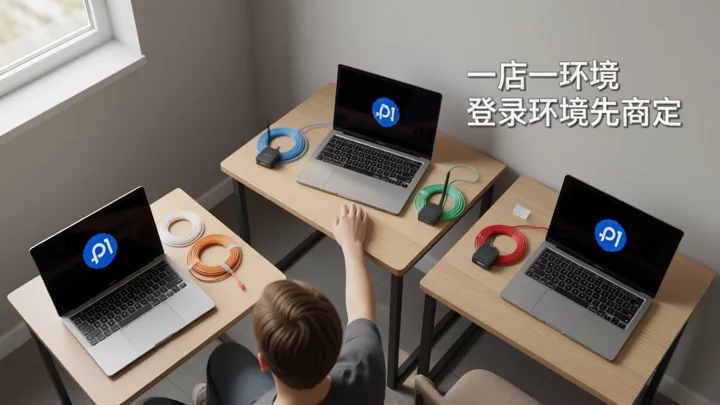
If you take the multi-store product-testing route, handle login environments and permissions first, then talk about content. Logging in and out of multiple store backends on the same device and in the same browser environment will leave overlapping signals between environments and account profiles; this is a type of clue that platform risk control watches for; whether it specifically triggers enforcement is determined by the platform, and it may result from a combination of multiple signals. Account notifications and official policies take precedence. For how to set it up, seeThe setup sequence for a store account isolation solution, andA retrospective on a cross-border store going from chaotic logins to stable operations.
After the platform is selected: don’t rush to spend money on ERP and agency operations
At the startup stage, first determine whether these two expenses are necessities. ERP is not a startup necessity: for a single platform with a few dozen orders per day, the platform backend plus a spreadsheet is enough; the trigger point is usually when orders exceed a hundred, or when you start operating more than two platforms at the same time. If you really need to select a solution, first look at four items: platform coverage, order synchronization and inventory deduction, team permissions, and migration cost; the tool tiering logic and trial-period acceptance steps can be cross-referencedComparison of Tool Selection for Cross-Border E-Commerce OperationsDetermine which layer of capability you should buy.

The same applies to agency operations: what you buy is execution efficiency; it will not bear inventory and account risks for you. When none of the three—product selection, content, and fulfillment—is working, the wrong direction will only be amplified in sync. Before deciding to outsource, define the boundaries clearly—ownership of accounts, advertising assets, and data belongs to you; the agency operations provider receives permissions by role and does not share main account credentials; TikTok Advertiser Account Policy also requires compliance with platform processes, and you must not bypass or interfere with the review process (TikTok Advertiser Account Policy).
One image shows where the startup thresholds on both sides differ
The chart below compares only one item: the relative magnitude of own funds that need to be tied up before the first order is successfully run through. Content investment and cash collection cycles are not included in the chart because they are not one-time expenses, but ongoing capacity and cash flow constraints.
Low capital tie-up does not mean it is easier to succeed: TikTok Shop presses costs onto content capacity, while Amazon presses costs onto inventory turnover. Choose the side you can continuously supply, not the side with the lower index.
Frequently Asked Questions
If the budget is only a few thousand yuan, which platform is more stable to start with?
Prioritize paths where failure costs can be recovered: use self-fulfillment to test a single Amazon product, or use a small number of samples plus self-shot materials to test TikTok Shop clicks. What they have in common is that the initial stocking amount is controllable, and even if you lose it, it won't hurt your cash flow. Don't use this money to directly stock FBA goods.
If I can't shoot short videos at all, does that mean Amazon is the only option?
Not necessarily, but you need to change your approach: work with creators, or directly buy real product footage for ad placements, and outsource your content production capacity. If you don't want to do either, TikTok Shop isn't suitable as your primary platform; you can wait until Amazon stabilizes and then use it as a secondary channel.
How long should self-fulfillment run before you should switch to FBA?
Don't look at time; look at the data: after several consecutive weeks of stable order volume, a controllable return rate, and a clear per-order landed cost, you can try switching. Before switching, add inbound, storage, and slow-moving inventory costs into the per-order cost and calculate again; if the numbers don't balance, wait one more cycle.
If you open three TikTok Shop stores at the same time to test products, what should you handle first?
Handle the login environment and permissions first, then content. Each store should have its own fixed environment and network exit, and team members should be assigned permissions by role rather than sharing the main account. Environment overlap is only one risk signal; whether to act on it is determined by the platform, and account notifications are the final authority.