


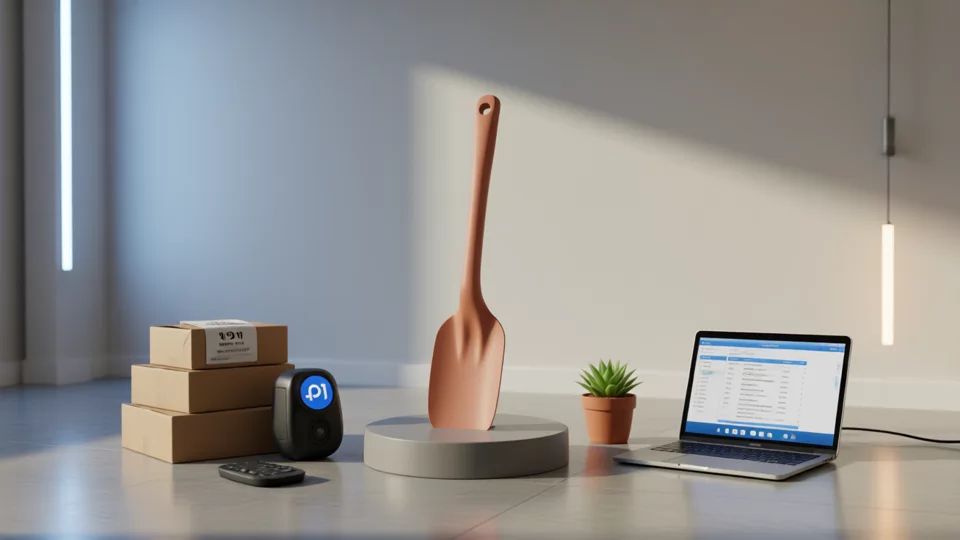
The same silicone kitchen spatula, Fully-Managed at 2000 units sold per month, gives the seller a net margin of about 11%; switching to Semi-Managed plus an overseas warehouse lifts the net margin to 19% at the same volume. The gap is not in the selling price — it is hidden in three places: warehouse rent, first-mile cost allocation, and platform fee percentage. Doing the math before picking a model is far more effective than optimizing the profit structure after the fact.
Same Product, Two Models: Where the Money Flows
Fully-Managed is essentially "a fixed-price procurement": the platform sets the procurement price based on market conditions (ex-factory cost + platform gross margin), and the seller's profit is locked in at signing. All subsequent logistics, warehousing, and last-mile delivery are borne by the platform; return losses are absorbed by the platform but pushed back into the procurement price. The seller does not touch the end consumer and has no room to raise prices.
Semi-Managed is "procurement + self-operations": the seller sets prices independently, and revenue is deducted in sequence — platform commission (approx. 15%) → advertising → logistics (overseas warehouse or consolidation) → storage fees → return reserve. The seller holds the choice of logistics route; per-unit cost fluctuates with weight tier and first-mile method, so profit is a variable, not a fixed value.
- Fully-Managed deduction path:Ex-factory price → Platform procurement price (includes platform gross margin) → Seller net profit, with no floating items in between
- Semi-Managed deduction path:Retail price → Commission → Advertising → Logistics → Warehousing → Return reserve → Seller net profit — logistics and returns are the two most volatile items
Operational roles and pricing authority: who does what, who has the final say
| Stage | Fully managed | Semi-managed |
|---|---|---|
| Product selection / Listing | The platform's product team leads selection; sellers supply the goods | Sellers independently select and list products |
| Pricing | The platform sets the retail price; sellers have no pricing authority | Sellers set the price; the platform imposes a minimum floor price |
| Shipping and warehousing | Platform warehouse / platform-designated logistics | Seller chooses an overseas warehouse or domestic consolidation |
| Customer service / Returns | Fully handled by the platform | Handled by the seller or delegated to the platform |
| Inventory replenishment | Platform places purchase orders | Seller replenishes independently |
| Payment collection cycle | Platform settlement cycle (typically 14 days) | Sales payment recovery; overseas warehouses can shorten this to 7 days |
Pricing power is the biggest profit lever in semi-managed models and the hardest ceiling sellers face under fully managed models. If you rely on platform traffic but cannot adjust prices independently, your profit ceiling is set by the purchase price formula, leaving zero room for peak-season price increases or off-season inventory clearance. When operating multiple accounts or across models, it is recommended to cross-check against account health and compliance boundaries.Amazon Official Multi-Seller Account Health GuideVerified.
Measured Logistics Costs: Per-Unit Break-Even Between Overseas Warehousing and Domestic Consolidation
To answer "which has lower logistics costs, overseas warehousing or domestic consolidation," the key variable is the parcel weight tier. The table below provides per-unit cost ranges for both channels across three typical weight tiers (including first-mile + storage + last-mile, excluding duties, for relative magnitude reference):
| Weight Tier | Domestic Consolidation (Per Unit) | Overseas Warehouse (Per Unit) | Cost Advantage |
|---|---|---|---|
| < 0.5 kg | 8 – 14 CNY | 12 – 20 CNY | Consolidation |
| 0.5 – 2 kg | 16 – 32 yuan | 20 – 35 yuan | Close, with group shipping slightly preferred |
| > 2 kg | 40 – 65 yuan | 30 – 48 yuan | Overseas warehouse |
2 kg is the switching threshold: light, small items go through group shipping, while medium-to-heavy items go through overseas warehouses. If the weight of the same SKU crosses the line, orders can be split across warehouses. On the export side, if using the 9610/9710 channels, the timing of tax refund payments will further affect cash-flow pressure. For specific filing and crediting procedures, seeA Four-Step Practical Guide to Customs Tax Refunds for Cross-Border E-Commerce.
Four hard criteria for model selection
If all four of the following are met, semi-managed + overseas warehouse delivers a superior profit structure; if any one is not met, full-managed is the safer choice:
- Average order value per SKU ≥ 80 USD— At low order values, logistics costs take up too large a share; after semi-managed deductions, net profit is thin
- Expected return rate ≤ 8%— Return reserves directly erode into the phone [product]
- Initial stocking ≥ 500 units— Overseas warehouse minimum dispatch volume and tiered storage rates only make sense at 500 units or above
- The team has the capability to coordinate with overseas warehouses— At least 1 person responsible for replenishment, inventory monitoring, and return handling
If any of the four criteria is missing, the full-managed model's "locked pricing" paradoxically becomes a risk buffer. Semi-managed, due to pre-stocking and overseas warehouse capital lock-up, has a capital tie-up cycle 30–45 days longer than full-managed; it is advisable to complete Startup capital budget broken down by platform and logistics model, confirm that cash flow peaks can be covered.
FAQ
How long does it take to switch from fully managed to semi-managed, and how is inventory transitioned?
Typically 4–6 weeks: the first two weeks complete overseas warehouse setup and initial stocking, the third week simultaneously launches semi-managed listings, and weeks four to six gradually transfer inventory out of the platform warehouse. During the transition period, both sides coexist; ensure that the same SKU does not have inverted pricing across the two models.
Who bears the return cost under semi-managed?
By default, the seller. Overseas warehouse returns use local reverse logistics, with a per-item handling cost of approximately 3–6 USD; delegating to the platform's return service incurs a service fee but the timeline is not guaranteed. Include the return SLA in the contract annex before signing.
How often is the fully managed procurement price adjusted, and is there room for negotiation?
Typically reviewed quarterly; before the peak season, the platform may reduce prices by 2–5% as a partnership incentive. Core leverage includes stable supply and exclusive SKUs; if raw material costs have risen for two consecutive quarters while the procurement price remains unchanged, prioritize negotiating volume-price linkage clauses.
Can both models coexist in the same store?
Yes, but within the same store, fully managed and semi-managed SKUs should be separated by category or by price tier to avoid same-page price comparisons that would undermine the price advantage of fully managed items. For principles on inventory routing and pricing synchronization, refer toKey points for multi-platform operational coordination.