


Three Amazon seller accounts simultaneously received Account Review notifications on day 15, with cross-contamination detected in inventory fields. Reviewing the operation logs: Store A and Store B had inventory writes performed by the same person within the same browser window, and Store C's financial collection was routed to Store A's receiving entity. No IP sharing, no fingerprint mixing—the problem lies in the task division itself. Amazon's officialMulti-Seller Account Health Noticemakes it clear that a policy issue on one account may affect related accounts, and the determination of "related" often begins with operational-level cross-over. What follows is organized in a directly actionable sequence.
Lock In Roles for All Three Stores Before Discussing Task Division
Before making any configuration, lock in an irreplaceable role for each store. If two stores share the same SKU pool and simultaneously accept inventory writes, they must be merged or re-divided. Common splits:
- Primary Clearance Storehandles mature SKUs, ships via FBA or third-party overseas warehouses, targeting turnover rate and cash flow;
- New Product Test Store: Small-batch product testing within 7 days of listing; inventory writes are restricted to a single operator on the store's backend;
- Overseas Warehouse Clearance Store: Handles unsold stock and return relisting; the SKU pool is fully segregated from the main store, and the logistics channel is independent.
Once roles are locked in, all downstream tool configurations, staffing schedules, and fund flows are organized around these three non-overlapping domains. If you are simultaneously running Amazon's multi-account semicolon strategy and account isolation, role definition is the first semicolon.
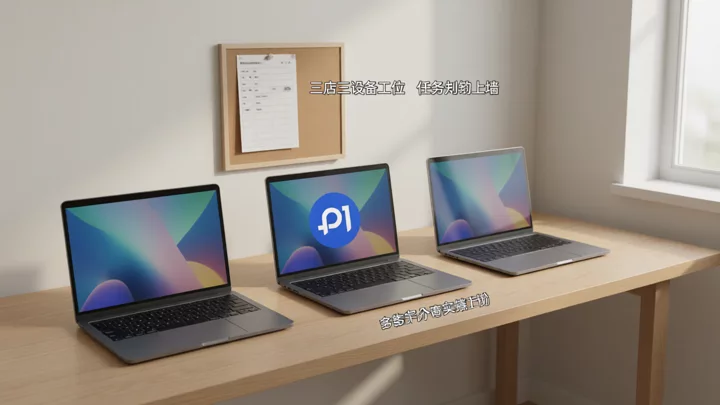
Task Partition Matrix: Who writes inventory, who processes orders, who publishes content, who collects payments
Distribute the four major task domains across the three stores, labeling each cell with a single assigned operator and the corresponding tool. Core principle:Inventory writes are restricted to a single entity (single-writer rule), order routing is hard-switched by region and logistics channel, and fund consolidation must correspond to independent receiving entities.
| Task Domain | Primary Clearance Store | New Product Test Store | Overseas Warehouse Clearance Store |
|---|---|---|---|
| Inventory Write-In | Operator A (ERP Single Entry Point) | Operator B (Store Backend, Manual) | Operator C (Overseas Warehouse WMS) |
| Order Routing | North America FBA | Europe FBM | Third-Party Overseas Warehouse Direct Shipping |
| Content Publishing | Brand Line A Visual | Brand Line B Visual | Standalone clearance page, unbranded |
| Fund Consolidation | Receiving Entity ① | Receiving Entity ② | Receiving Entity ③ |
Print this table and post it at the workstation. If any cell shows "the same person operating two stores simultaneously," immediately return to the role-locking step and reassign. If the receiving entities have not been fully split, you can first refer to 5 Key Steps for Registering a Cross-Border E-Commerce Receiving Account, complete the entity consistency check before going live.
Minimum Breakpoint Configuration for Five-Layer Isolation
Do not try to max out all five layers before going live. Each layer only needs one structural breakpoint to exist; if any layer is missing, all subsequent layers are essentially wasted.
- IP / Network Layer: Three stores each use a separate outbound IP. The breakpoint is that the IP must change when switching stores. Logging into three stores from the same home broadband outlet is invalid.
- Browser Fingerprint & Tool Layer: Each store corresponds to an independent browser profile. You can use P1Browser's multi-account isolation mode to generate a unique fingerprint environment for each store, or manually set up three physical machines—the test is whether the User-Agent and Canvas fingerprints of two stores are distinguishable. If you choose the tool-based approach, refer to the actual time cost of multi-account switching in cross-border store management tools.
- Payment Receiving Entity Layer: Three stores correspond to three independent third-party receiving accounts. Two stores must never share the same consolidated fund. Breakpoint verification: sever the payment path of any one store; the cash flow of the other two must remain unaffected.
- Content Asset Ownership Layer: Images, A+ copy, and brand registrations must belong to different corporate entities or at least different trademark numbers. The breakpoint is that two stores must not reference the same source asset file.
- Operation Timing Layer: The same operator must not log into two stores consecutively within a 4-hour window. The break point is that the two stores' operation windows on the calendar must not overlap, rather than merely "staggering as much as possible."
If any of the five layers reverts to a parallel-configuration state, Amazon's risk-control engine will most likely flag in bulk on day 14–21. For specific signals and triage priority, see 5 Signals That Trigger Related Account Bans in Amazon Multi-Account Operations and Triage Steps.
48-Hour Verification Protocol and Three High-Frequency Failure Boundaries
Three actions that must be completed within 48 hours of configuration:① Log into each of the three store back-ends using three independent IPs and confirm there are no cross-popups; ② Write a single inventory entry into Store A and verify that the same SKU field in Stores B and C shows no change (it must be zero); ③ Review the payment-account binding pages of all three stores and confirm that the collection paths do not route through another store's entity. Daily operations may resume only after all three checks pass.
Three boundaries most prone to failure after week three:
- New-Product Test Store Liquidation Write-Back: After the test period ends, do not write inventory back into the main store's fields. At this stage, liquidation SKUs must be assigned to the overseas-warehouse liquidation store; reverse writing is prohibited.
- Returns Re-Entered into FBA: Returns from the overseas warehouse clearance store are being resent to the main store's FBA, causing SKU ownership confusion. At this point, lock that SKU in the return WMS to belong exclusively to the clearance store, and the main store's FBA should no longer accept that batch.
- Overlapping Vacation Delegation: Team vacation delegation by the same person for both stores causes the temporal layer to fail. In this case, switch the managed store's login IP and device fingerprint to the delegate's independent configuration in advance, and mark on the calendar that operation time slots do not overlap.
Frequently Asked Questions
Can three stores share one ERP backend to view data?
Read-only access is permitted; writing is not. The ERP inventory sync module must have independent write permissions configured per store. Any "one-click sync all stores" toggle must remain off; otherwise, the single-writer principle is violated.
What should you do first within 48 hours of receiving an Account Review on day 15?
First, stop all inventory write and new listing actions, preserve the original operation logs, then take screenshots layer by layer across the five-layer breakpoints for evidence. Do not rush to file an appeal; prioritize rolling back the cross-contaminated fields to the pre-incident snapshot.
Does sharing one overseas warehouse physical space between two stores trigger an association?
Physical warehouse sharing itself is not a determining signal, but if SKU labels inside the warehouse mix the same batch barcode, Amazon will identify it as cross-contamination during return inbound processing. Per the role-lock principle, the warehouse bin locations for the main store and the clearance store must be physically separated.
With only 2 people on the team, how do you ensure operation time slots do not overlap?
Split the 5 working days of a week into fixed 2.5-day slots per person, with the remaining 0.5 day as buffer. Any ad-hoc overtime login must be declared on the shared calendar 24 hours in advance to avoid colliding with the other person's time slot.