



Three Amazon Accounts Oversold in 40 Minutes—Seller Central's Dashboard Can't Save You
Tuesday 14:02, NA-region Account A received an order for SKU-0347. At 14:19, the same SKU on EU-region Account B still showed "In stock: 12 units." At 14:41, customer service simultaneously received two unfulfillable return requests. That 40-minute sync window is the gap between when inventory is "deducted" and when it becomes "visible across all accounts." This isn't an isolated incident—our team has been running three accounts on Amazon Seller Central's native backend for six months, and this is the third time an oversell was caused by conflicting inventory write sequences.
The root cause isn't the number of accounts—it's that no single writer has been designated across the three lines: inventory, pricing, and order routing. Amazon's official multi-account health guidance explicitly states that a policy issue on one account can cascade to linked accounts; when three accounts share the same warehouse and sync pipeline, timing gaps become compliance risks. If your multi-account operations have been triggering linked-account alerts frequently, we recommend following thesignal-layer decomposition and layer-by-layer audit steps.First rule out cross-layer stacking, then decide whether to switch tools or restructure the architecture.
Test conditions: 5 tools × 3 Amazon accounts × 200 SKUs × 7 days
- Tools:Amazon Seller Central's built-in bulk sync feature + 4 third-party store management tools (referred to as T-A through T-D below)
- Accounts:3 Amazon seller accounts (NA / EU / JP) + 1 eBay seller account, sharing the same 3PL warehouse
- SKU pool:200 SKUs, average inventory of 80 units per SKU, covering 4 categories
- Team:2 operations + 1 customer support, 40 hours/week
- Success criteria:Inventory sync latency ≤ 90 s, order to customer support acknowledgment ≤ 120 s, zero oversell incidents within 7 days
The complete multi-account architecture setup—including how to compress 12 cross-border accounts into 3 groups by sync cadence—can be found inA Hands-On Guide to Running 12 Cross-Border Accounts in a Single Window. This test focuses on "whether the tools can hard-code the three lines" and does not involve multi-account topology design.
Account Architecture and Synchronization Topology
The diagram below marks the inventory write paths for the 4 accounts in the test: the 3PL warehouse is the sole physical inventory source, and each sync line permits only one writer. Break points typically occur where the two lines — "Warehouse → Platform A" and "Warehouse → Platform B" — share the same webhook queue and write priority has not been locked.
Measured Sync Latency and Order Processing Time
Bar height represents the P95 latency relative index (0–100 scale; lower values indicate faster performance). The seller center's built-in features reach a P95 of 92 units under a 200 SKU load, exceeding the 90 s threshold; T-A allows three accounts to write inventory independently, triggering a 47 s timing-gap oversell on Day 2; T-D's webhook queue degrades to a P95 of 55 units (approximately 94 s actual latency). Only T-C remains stable at 28 units (approximately 42 s), with zero oversells over 7 days.
The only zero-oversell solution wins by hard-locking write ownership
T-C's core mechanism: inventory writes are executed by 1 central node only, pricing routing is locked by region at SKU creation, and order ownership is bound to a single account at the moment of creation. The other 4 tools each have different failure points — T-A and T-B allow multi-account parallel inventory writes (timing gaps cause oversells), and T-D's sync pipeline sees webhook latency degrade from 2.3 s to 94 s under 200 SKU load. In cross-platform scenarios, the ownership logic across the three sync lines (inventory writes, pricing routing, order ownership) compared with additional tools — seeA Real Efficiency Comparison of Cross-Platform Store Management Tools.
Write Ownership Configuration Logic of the Winning Tool
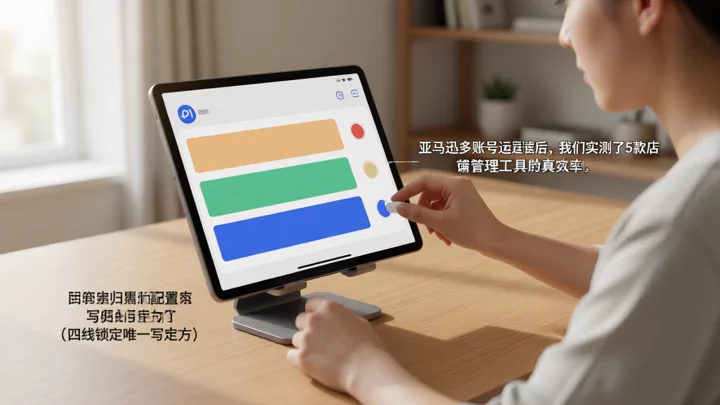
The panel above shows T-C's "sole write owner" configuration across 3 Amazon accounts + 1 eBay account: the inventory line is owned by the central node, the pricing line is locked by region, and the order line is bound at the moment of creation. Compare this against your existing tools — the core checkpoint is: can you clearly see in the backend "who alone is writing to this line," rather than every account being able to trigger a write.
When to Add a Tool vs. When to Add a Person
- Accounts ≥ 5 or SKUs ≥ 800:Single-tool sync latency will inevitably exceed 120 s; split into two groups of write nodes (e.g., NA+EU as one group, JP+eBay as another), each with its own independent central writer.
- Team ≥ 4 people:Operation-timeline isolation is mandatory—different people operate different accounts at different time slots. For a layer-by-layer self-check of the five signal layers (network egress, device fingerprint, payment entity, operation timeline, tool crossover), refer to the5 Amazon Seller Account Association Risk-Control Self-Check Listfor execution.
- Adding TikTok Shop or Temu accounts:The number of write lines doubles. If the existing tool does not support multi-platform same-window management, you must switch or layer tools. Differences in content distribution and inventory synchronization across multiple TikTok Shop accounts should be evaluated separately.
FAQ
Must a newly opened Temu account share the same tool as Amazon?
Not necessarily. Temu's inventory write cadence (daily batches) differs significantly from Amazon's (real-time webhook). If the tool does not support dual-cadence switching, simply assign a lightweight inventory sync module to Temu separately; order routing remains with the central node.
Is the built-in functionality of Seller Central sufficient for small teams with fewer than 200 SKUs?
With 2 accounts and fewer than 100 SKUs, the built-in batch sync in Seller Central is mostly sufficient. But the moment you add the 3rd account or SKUs exceed 200, write timing discrepancies will scale rapidly—go straight to a tool with a central write node.
Tool sync latency meets the target yet order processing still times out—where is the bottleneck usually?
In most cases it stalls at the CS order-intake stage: when order ownership isn't bound to a single account, the same order appears once in each backend, and CS agents have to manually deduplicate. Confirm that the tool completes ownership binding at the instant of order creation, rather than relying on CS judgment.
Is a 7-day test window long enough? How long do you need to run it before you can call the tool reliable?
7 days covering two full promotional cycles (Monday low-price + Friday Prime Day simulation) is the minimum bar. If the tool logs zero oversells within 7 days, run a further 14 days including one real mega-sale to verify P95 stability. Passing a single test doesn't mean long-term reliability.

